What is \(45{,}782\) rounded to the nearest thousand?
- \(45{,}000\)
- \(45{,}800\)
- \(46{,}000\)
- \(50{,}000\)


Students will round multi-digit whole numbers to any specified place using place-value reasoning.
Choose a free PDF. Each has different questions and worked solutions. The preview shows the student question page; open the PDF to read or print it at full size.
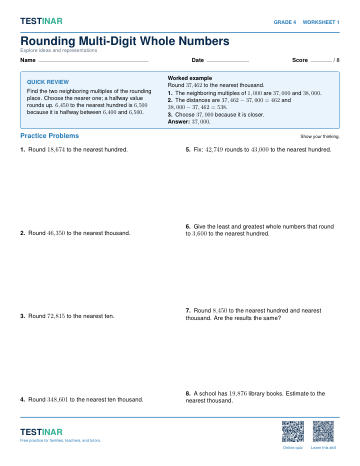 Worksheet 1
8 problems
Includes math models and calculations.
Open PDF
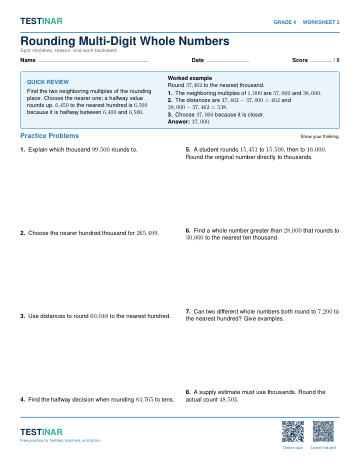 Worksheet 2
8 problems
Includes correcting mistakes and working backward.
Open PDF
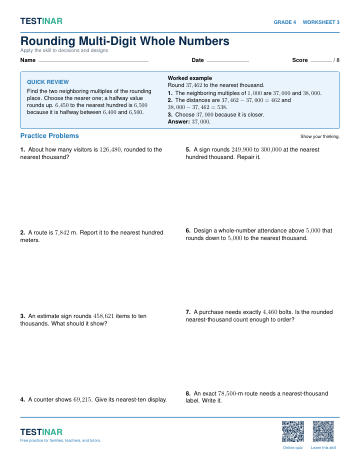 Worksheet 3
8 problems
Includes word problems and math models.
Open PDF
Print page 1 for students. Page 2 has the solutions; page 3 has optional book recommendations.
These online questions are separate from the three PDF worksheets above.
What is \(45{,}782\) rounded to the nearest thousand?
Round \(3{,}264\) to the nearest hundred.
What is \(7{,}149\) rounded to the nearest ten?
Which number rounds to \(5{,}000\) when rounded to the nearest thousand?
Round \(8{,}756\) to the nearest hundred.
What is \(12{,}389\) rounded to the nearest thousand?
Round \(56{,}841\) to the nearest thousand.
Round \(31{,}456\) to the nearest hundred.
We're rounding to the nearest thousand. Look at the hundreds digit: \(7\). Since \(7 \geq 5\), we round UP! Change the thousands digit from \(5\) to \(6\), and the answer is \(\mathbf{46{,}000}\). \checkmark
We're rounding to the nearest hundred. Look at the tens digit: \(6\). Since \(6 \geq 5\), we round UP! The hundreds digit goes from \(2\) to \(3\), giving us \(\mathbf{3{,}300}\). \checkmark
We're rounding to the nearest ten. Look at the ones digit: \(9\). Since \(9 \geq 5\), we round UP! The tens digit changes from \(4\) to \(5\), so the answer is \(\mathbf{7{,}150}\). \checkmark
To round to the nearest thousand, check the hundreds digit in \(5{,}450\): it's \(4\). Since \(4 < 5\), we round DOWN to \(\mathbf{5{,}000}\). \checkmark
We're rounding to the nearest hundred. Look at the tens digit: \(5\). Since \(5 \geq 5\), we round UP! The hundreds digit goes from \(7\) to \(8\), giving us \(\mathbf{8{,}800}\). \checkmark
We're rounding to the nearest thousand. Look at the hundreds digit: \(3\). Since \(3 < 5\), we round DOWN and keep the thousands digit as \(2\), giving us \(\mathbf{12{,}000}\). \checkmark
We're rounding to the nearest thousand. Look at the hundreds digit: \(8\). Since \(8 \geq 5\), we round UP! The thousands digit changes from \(6\) to \(7\), so the answer is \(\mathbf{57{,}000}\). \checkmark
We're rounding to the nearest hundred. Look at the tens digit: \(5\). Since \(5 \geq 5\), we round UP! The hundreds digit changes from \(4\) to \(5\), giving us \(\mathbf{31{,}500}\). \checkmark
