What is \(1\frac{1}{6} + \frac{1}{4} + \frac{1}{12}\)?
- \(1\frac{1}{4}\)
- \(1\frac{1}{3}\)
- \(1\frac{5}{12}\)
- \(1\frac{1}{2}\)


Students will add and subtract mixed numbers with unlike denominators and simplify results.
What is \(1\frac{1}{6} + \frac{1}{4} + \frac{1}{12}\)?
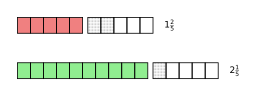
Add: \(1\frac{2}{5} + 2\frac{1}{5}\)
Add: \(3\frac{1}{4} + 1\frac{3}{4}\)
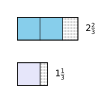
Add: \(2\frac{2}{3} + 1\frac{1}{3}\)
Add: \(1\frac{1}{6} + 2\frac{2}{6}\)
A recipe calls for \(1\frac{1}{2}\) cups flour and \(\frac{3}{4}\) cup sugar. Total needed?
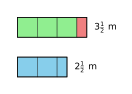
Two fabric pieces: \(3\frac{1}{2}\) m and \(2\frac{1}{2}\) m. Total length?
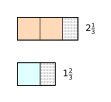
Add: \(2\frac{1}{3} + 1\frac{2}{3}\)
Use denominator 12: \(1\frac{1}{6}=1\frac{2}{12}\), \(\frac{1}{4}=\frac{3}{12}\), and \(\frac{1}{12}\) stays the same. The fractional parts add to \(\frac{2}{12}+\frac{3}{12}+\frac{1}{12}=\frac{6}{12}=\frac{1}{2}\), so the sum is \(1\frac{1}{2}\).
Add whole parts: \(1 + 2 = 3\). Add fractions: \(\frac{2}{5} + \frac{1}{5} = \frac{3}{5}\). Result: \(3\frac{3}{5}\).
Add whole parts: \(3 + 1 = 4\). Add fractions: \(\frac{1}{4} + \frac{3}{4} = 1\). Total: \(4 + 1 = 5\).
Add whole parts: \(2 + 1 = 3\). Add fractions: \(\frac{2}{3} + \frac{1}{3} = 1\). Total: \(3 + 1 = 4\).
Add whole parts: \(1 + 2 = 3\). Add fractions: \(\frac{1}{6} + \frac{2}{6} = \frac{3}{6} = \frac{1}{2}\). Result: \(3\frac{1}{2}\).
Convert \(1\frac{1}{2}\) to \(\frac{6}{4}\). Add: \(\frac{6}{4} + \frac{3}{4} = \frac{9}{4} = 2\frac{1}{4}\) cups.
Add whole parts: \(3 + 2 = 5\). Add fractions: \(\frac{1}{2} + \frac{1}{2} = 1\). Total: \(5 + 1 = 6\) m.
Add whole parts: \(2 + 1 = 3\). Add fractions: \(\frac{1}{3} + \frac{2}{3} = 1\). Total: \(3 + 1 = 4\).
