Look at the pattern: \(2, 20, 200, 2{,}000, \ldots\) What is the next number?
- \(2{,}002\)
- \(2{,}000{,}000\)
- \(200{,}000\)
- \(20{,}000\)


Students will analyze relationships between two numerical patterns and explain the connection.
Look at the pattern: \(2, 20, 200, 2{,}000, \ldots\) What is the next number?
The pattern \(5, 10, 15, 20, \ldots\) adds the same amount each time. Which choice gives the rule and the 8th term?
Pattern: \(64, 32, 16, 8, \ldots\) What's next?
Pattern: \(3, 6, 12, 24, \ldots\) What's next?
Pattern: \(100, 90, 80, 70, \ldots\) What is the 8th term?
Pattern A is \(1, 2, 3, 4, \ldots\) and Pattern B is \(3, 6, 9, 12, \ldots\). If Pattern A gives the \(x\)-value and Pattern B gives the \(y\)-value, what ordered pair comes next?
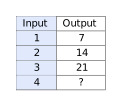
The table shows a pattern. What is the missing value?
Pattern A has dots \(1,4,7,10,\ldots\). Pattern B has dots \(2,8,14,20,\ldots\). Which statement describes the relationship between matching figures?
Each term is multiplied by 10: \(2{,}000 \times 10 = 20{,}000\).
The pattern grows by 5 each time. Counting terms gives \(5,10,15,20,25,30,35,40\), so the 8th term is 40.
Each term is half the previous: \(8 \div 2 = 4\).
Each term is twice the term before it: \(3\) becomes \(6\), \(6\) becomes \(12\), and \(12\) becomes \(24\). Keep that same rule, so \(24 \times 2 = 48\).
Subtract 10 each time: 100, 90, 80, 70, 60, 50, 40, 30.
Pattern A adds 1 each time and Pattern B adds 3 each time. The next matching values are 5 and 15, so the next ordered pair is \((5,15)\).
Rule: Output \(= 7 \times\) Input; \(7 \times 4 = 28\).
Compare matching figures: \(2=2\times1\), \(8=2\times4\), \(14=2\times7\), and \(20=2\times10\). Pattern B has twice as many dots as Pattern A.
