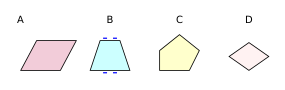
Which figure is described as having exactly one pair of parallel sides and is not a parallelogram?
- Figure A
- Figure B
- Figure C
- Figure D


Students will classify triangles and quadrilaterals using properties and hierarchy.
Which figure is described as having exactly one pair of parallel sides and is not a parallelogram?
Which statement is true?
Which statement correctly explains the relationship between squares and rectangles?
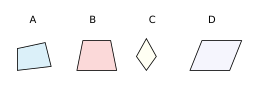
Which figure is a parallelogram?
Every rhombus must have:
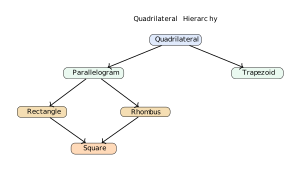
According to the hierarchy, which is true?
Which attribute does NOT belong to every rectangle?
A quadrilateral has exactly one pair of parallel sides. What is the most specific name for this figure?
Figure B is described as having exactly one pair of parallel sides, so it is not a parallelogram. Figures A and D are in the parallelogram family because they have two pairs of parallel sides.
A square has four right angles and opposite sides parallel, so it meets the definition of a rectangle. A square is a special type of rectangle.
A square has all the properties of a rectangle: four right angles and two pairs of parallel sides. A rectangle does not need to have all four sides equal, so not every rectangle is a square.
A parallelogram has two pairs of parallel sides. Figure D has two pairs of opposite sides parallel; Figures A, B, and C do not.
A rhombus is a quadrilateral with all four sides equal in length. It does not have to have four right angles.
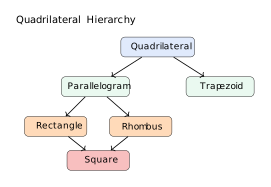
The hierarchy shows that Square is a child of Rectangle, meaning every square is also a rectangle. Not every rectangle is a square.
A rectangle must have four right angles and opposite sides parallel, but the sides do not have to all be equal. A square has all equal sides, but a rectangle does not.
Using this definition, a quadrilateral with exactly one pair of parallel sides is a trapezoid. Rectangles, rhombuses, and squares have two pairs of parallel sides.
