What is \(5 \div \frac{1}{3}\)?
- \(\frac{5}{3}\)
- \(\frac{1}{15}\)
- 15
- 8


Students will divide whole numbers by unit fractions using models and equations.
What is \(5 \div \frac{1}{3}\)?
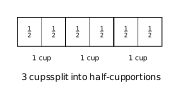
How many one-half cups are in 3 cups?
What is \(4 \div \frac{1}{4}\)?
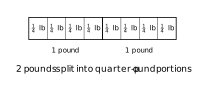
A baker has 2 pounds of flour. She uses \(\frac{1}{4}\)-pound portions for each loaf. How many loaves can she make?
What is \(6 \div \frac{1}{2}\)?
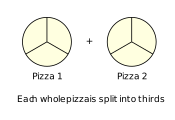
How many one-third pizzas fit in 2 whole pizzas?
What is \(7 \div \frac{1}{4}\)?
A recipe calls for \(\frac{1}{3}\)-cup servings of sugar. How many servings are in 4 cups?
Dividing by \(\frac{1}{3}\) asks how many one-third pieces are in 5 wholes. Each whole has 3 thirds, so \(5 \div \frac{1}{3} = 5 \times 3 = 15\).
\(3 \div \frac{1}{2} = 3 \times 2 = 6\). There are 6 half-cups in 3 cups.
\(4 \div \frac{1}{4} = 4 \times 4 = 16\). Multiply the whole number by the denominator.
\(2 \div \frac{1}{4} = 2 \times 4 = 8\). She can make 8 loaves.
\(6 \div \frac{1}{2} = 6 \times 2 = 12\).
\(2 \div \frac{1}{3} = 2 \times 3 = 6\). There are 6 one-third pizzas in 2 whole pizzas.
\(7 \div \frac{1}{4} = 7 \times 4 = 28\).
\(4 \div \frac{1}{3} = 4 \times 3 = 12\). There are 12 servings.
