Estimate: \(\frac{1}{8} + \frac{7}{8}\).
- \(0\)
- \(\frac{1}{2}\)
- \(1\)
- \(2\)


Students will estimate fraction sums and differences using benchmarks and number sense.
Estimate: \(\frac{1}{8} + \frac{7}{8}\).
Estimate: \(\frac{4}{9} + \frac{1}{12}\). Which benchmark is the best estimate?
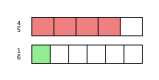
Estimate: \(\frac{4}{5} + \frac{1}{6}\).
Estimate: \(3\frac{2}{7} + 1\frac{1}{8}\).
Which benchmark is closest to the sum \(\frac{3}{8}+\frac{2}{7}\)?
Estimate: \(5\frac{6}{7} - 2\frac{1}{9}\).
Estimate each expression. Which result is closest to \(0\)?
Which expression has a sum close to \(2\)?
\(\frac{1}{8}\) is close to 0, and \(\frac{7}{8}\) is close to 1. So \(\frac{1}{8} + \frac{7}{8} \approx 0 + 1 = 1\).
\(\frac{4}{9}\) is close to \(\frac{1}{2}\), and \(\frac{1}{12}\) is small. The sum is just a little more than \(\frac{1}{2}\), so \(\frac{1}{2}\) is the best benchmark estimate.
\(\frac{4}{5}\) is close to 1, and \(\frac{1}{6}\) is close to 0. So \(\frac{4}{5} + \frac{1}{6} \approx 1 + 0 = 1\).
\(3\frac{2}{7} \approx 3\) and \(1\frac{1}{8} \approx 1\). So \(3\frac{2}{7} + 1\frac{1}{8} \approx 3 + 1 = 4\).
\(\frac{3}{8}+\frac{2}{7}=\frac{37}{56}\approx0.66\). That is closer to \(\frac{1}{2}\) than to \(1\), so \(\frac{1}{2}\) is the best benchmark choice.
\(5\frac{6}{7} \approx 6\) and \(2\frac{1}{9} \approx 2\). So \(5\frac{6}{7} - 2\frac{1}{9} \approx 6 - 2 = 4\).
Both fractions in choice A are very small, so their sum is close to 0. The other choices are much closer to \(\frac{3}{4}\), 1, or 2.
\(1\frac{1}{12} \approx 1\) and \(\frac{7}{8} \approx 1\). So \(1\frac{1}{12} + \frac{7}{8} \approx 1 + 1 = 2\). All others sum to less than 1.
