CH07-01 lesson

Evaluating Expressions with Grouping Symbols Learning Activity

A focused Grade 5 learning session for Evaluating Expressions with Grouping Symbols using visual models, worked examples, strategy guidance, and a short mastery check.

15
minutes
6
lesson parts
11
practice items
Learning goal

Students will evaluate expressions that include parentheses, brackets, and braces.

Student goal: I can evaluate expressions with grouping symbols.

concept

Learn the Idea

Evaluating Expressions with Grouping Symbols is the Grade 5 skill of students use parentheses, brackets, and braces in numerical expressions and evaluate expressions containing these symbols. They follow the order of operations and understand that grouping symbols indicate which operations to perform first.


What do the numbers represent, and what strategy shows the idea clearly?

Strong understanding comes from naming what the numbers, shapes, units, or data values represent, then showing the idea with a model or clear steps before solving.

The key to this topic is understanding the structure behind the work, not just following a rule. Students should be able to talk through what is happening, point to a model, and explain why the answer makes sense.

  • Identify what each number, unit, or symbol means before solving.
  • Choose a model or strategy that makes the relationship visible.
  • Explain why the answer fits the situation instead of stopping at computation.
  • Use the topic language from class discussions: Students use parentheses, brackets, and braces in numerical expressions and evaluate expressions containing these symbols. They follow the order of operations and understand that grouping symbols indicate which operations to perform first.
visual model

See the Math

Visual Model 1

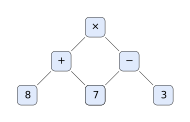
Question: The expression tree shows how to evaluate the grouped expression \(((8+2)\times(7-3))\). What is the final value?

Grade 5 Evaluating Expressions with Grouping Symbols figure 1

  • A. \(30\)
  • B. \(60\)
  • C. \(50\)
  • D. \(40\)

How the model helps: The tree says to find each branch first: \(8+2=10\) and \(7-3=4\). Then multiply the two results: \(10 \times 4 = 40\).

worked example

Follow a Worked Example

Example 1

Question: Compare the two expressions. Which statement is true?

Grade 5 Evaluating Expressions with Grouping Symbols figure 2

  • A. Left \(>\) Right
  • B. Left \(<\) Right
  • C. Left \(=\) Right
  • D. Cannot compare
  1. The grouping changes the value.
  2. The left expression is \((12+8)\div4=20\div4=5\), while the right expression is \(12+(8\div4)=12+2=14\).
  3. Since \(5<14\), the left side is less.

Answer: Left \(<\) Right

Example 2

Question: Mia wrote four expressions. Which one has a value of \(18\)?

A\(3 \times (4 + 2)\)
B\((3 \times 4) + 2\)
C\(3 + 4 \times 2\)
D\((3 + 4) \times 2\)
  • A. A
  • B. B
  • C. C
  • D. D
  1. Check each choice instead of guessing.
  2. A is \(3 \times 6=18\), while B \(=14\), C \(=11\), and D \(=14\), so only A has a value of 18.

Answer: A

real world

Connect It to a Real Situation

Problem 1

Question: The table shows four students' evaluations of the expression \(10 + (3 \times 4) - 2\). Which student is correct?

StudentAnswer
Alex\(50\)
Bella\(20\)
Carla\(22\)
Dan\(12\)
  • A. Alex
  • B. Bella
  • C. Carla
  • D. Dan

Answer: Bella

Why it works: Multiplication inside the parentheses comes first: \(3 \times 4=12\). Then \(10+12=22\), and \(22-2=20\), so Bella has the correct answer.

strategy

Avoid Mistakes and Choose a Strategy

  • Starting the computation before identifying what the numbers, units, or parts represent.
  • Skipping the model or visual and relying only on a memorized rule.
  • Forgetting to estimate, which makes it easier to miss an unreasonable answer.
  • Stopping at a number without explaining what the answer means in context.
  • Read the situation slowly and name what each number or label represents.
  • Use a model, table, chart, number line, or sketch before finishing the computation.
  • Estimate first so you already know the answer's approximate size.
  • Check the answer with an inverse operation, another representation, or a sentence explanation.
  • Say the math idea out loud in simple words before writing the final answer.
summary

Remember the Key Idea

Evaluating Expressions with Grouping Symbols gets easier when students read the model, track what each number means, and explain why the answer fits the situation.

GOLDEN RULE

Understand the structure first, then solve, check, and explain why the answer makes sense.

Guided to independent practice

Solve before opening the answer

Use scratch paper. The explanation matters more than simply seeing whether the choice is correct.

warmup

2 questions
G5-C01-T01-Q001 About 1 min

Which expression represents four groups of the quantity \((6+2)\)?

  1. A \(4 \times (6 + 2)\)
  2. B \((4 \times 6) + 2\)
  3. C \(4 + (6 \times 2)\)
  4. D \((4 + 6) \times 2\)
Check answer and explanation

Answer A: \(4 \times (6 + 2)\)

The words "four groups of the quantity \((6+2)\)" mean the grouped quantity is multiplied by 4. That is represented by \(4 \times (6+2)\).

G5-C01-T01-Q002 About 1 min

Evaluate the expression: \((4 + 5) \times 2\)

  1. A \(11\)
  2. B \(14\)
  3. C \(18\)
  4. D \(20\)
Check answer and explanation

Answer C: \(18\)

Start with the part in parentheses: \(4 + 5 = 9\). Now multiply the result by 2: \(9 \times 2 = 18\). Nice careful grouping gives answer C.

guided

1 question
G5-C01-T01-Q003 About 1 min

Evaluate: \(20 - (3 \times 4)\)

  1. A \(6\)
  2. B \(8\)
  3. C \(17\)
  4. D \(68\)
Check answer and explanation

Answer B: \(8\)

The parentheses tell you what to do first. Since \(3 \times 4 = 12\), the expression becomes \(20 - 12\), which equals 8.

practice

5 questions
G5-C01-T01-Q004 About 1 min

Where should parentheses be placed to make the expression equal \(20\)? \(\)6 + 4 \times 2\(\)

  1. A \((6 + 4) \times 2\)
  2. B \(6 + (4 \times 2)\)
  3. C \(6 \times (4 + 2)\)
  4. D \((6 \times 4) + 2\)
Check answer and explanation

Answer A: \((6 + 4) \times 2\)

To make 20, group the addition first: \((6+4) \times 2 = 10 \times 2 = 20\). The other choices give different values, so A is the only match.

G5-C01-T01-Q005 About 1 min

Evaluate the expression: \(\)[\,2 + (3 \times 4)\,] \div 7\(\)

  1. A \(1\)
  2. B \(2\)
  3. C \(5\)
  4. D \(14\)
Check answer and explanation

Answer B: \(2\)

Work from the inside out. First \(3 \times 4 = 12\), then the bracket becomes \([2+12]=14\), and finally \(14 \div 7 = 2\).

G5-C01-T01-Q006 About 1 min

The expression tree shows how to evaluate the grouped expression \(((8+2)\times(7-3))\). What is the final value?

Using Parentheses Brackets and Braces in Numerical Expressions visual for G5-C01-T01-Q006
  1. A \(30\)
  2. B \(60\)
  3. C \(50\)
  4. D \(40\)
Check answer and explanation

Answer D: \(40\)

The tree says to find each branch first: \(8+2=10\) and \(7-3=4\). Then multiply the two results: \(10 \times 4 = 40\).

G5-C01-T01-Q007 About 1 min

Evaluate: \(30 - \{\,4 + (2 \times 3)\,\}\)

  1. A \(20\)
  2. B \(24\)
  3. C \(26\)
  4. D \(34\)
Check answer and explanation

Answer A: \(20\)

Begin with the innermost operation: \(2 \times 3 = 6\). That makes the braces \(\{4+6\}=10\), so the full expression is \(30-10=20\).

G5-C01-T01-Q008 About 1 min

Evaluate: \((8 + 2) \times (3 - 1)\)

  1. A \(10\)
  2. B \(15\)
  3. C \(20\)
  4. D \(25\)
Check answer and explanation

Answer C: \(20\)

Each set of parentheses gives you a small problem to solve first: \((8+2)=10\) and \((3-1)=2\). Multiply those results to get \(10 \times 2 = 20\).

exit

3 questions
G5-C01-T01-Q009 About 1 min

Evaluate: \((15 \div 3) + 7\)

  1. A \(9\)
  2. B \(10\)
  3. C \(12\)
  4. D \(22\)
Check answer and explanation

Answer C: \(12\)

The parentheses come first, so \(15 \div 3 = 5\). After that, add 7: \(5+7=12\).

G5-C01-T01-Q010 About 1 min

Evaluate: \(50 \div (2 \times 5)\)

  1. A \(5\)
  2. B \(10\)
  3. C \(25\)
  4. D \(125\)
Check answer and explanation

Answer A: \(5\)

The divisor is the grouped expression. First find \((2 \times 5)=10\), then divide: \(50 \div 10 = 5\).

G5-C01-T01-Q011 About 1 min

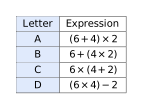
The table shows four expressions. Which has the greatest value?

Using Parentheses Brackets and Braces in Numerical Expressions visual for G5-C01-T01-Q011
  1. A A
  2. B B
  3. C C
  4. D D
Check answer and explanation

Answer C: C

Evaluate each expression carefully: A \(=20\), B \(=14\), C \(=36\), and D \(=22\). Since 36 is the greatest value, choice C is correct.

Page UP