

Testinar Grade 5 math

Generating Number Patterns

Students will generate number patterns and represent ordered pairs from related rules.

CH07-03 Expressions and Patterns
Name
Date
Score
____ / 8
Directions Solve each problem. Show your reasoning on the page or on separate paper. Check the answer key only after finishing.
  1. Look at the pattern in the table: What rule describes this pattern, and what is the missing output for input 5?
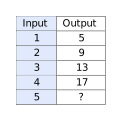
    Ordered Pairs from Number Patterns visual for G5-C01-T09-Q001
    1. Add 4 to the input; Output \(=9\)
    2. Multiply input by 4 and add 1; Output \(=21\)
    3. Multiply input by 3 and add 2; Output \(=17\)
    4. Multiply input by 4 and subtract 1; Output \(=19\)
  2. The inputs are 1, 2, 3, 4 and the matching outputs are 3, 6, 9, 12. What ordered pair represents the 4th term?

    1. \((4, 12)\)
    2. \((4, 15)\)
    3. \((3, 9)\)
    4. \((12, 4)\)
  3. For the rule "double the input, then add 3," which ordered pairs are correct for inputs 0, 1, 2, and 3?

    1. \((0,3), (1,5), (2,7), (3,9)\)
    2. \((0,2), (1,3), (2,4), (3,5)\)
    3. \((0,0), (1,2), (2,4), (3,6)\)
    4. \((3,0), (5,1), (7,2), (9,3)\)
  4. Two patterns start at 0. Pattern P adds 3 each time; pattern Q adds 6 each time. List the first four ordered pairs \((P,Q)\), including the starting values.

    1. \((0,0), (3,6), (6,12), (9,18)\)
    2. \((0,0), (3,3), (6,6), (9,9)\)
    3. \((0,0), (6,3), (12,6), (18,9)\)
    4. \((0,0), (3,6), (9,12), (18,24)\)
  5. In a pattern, \(y\) is always double \(x\). Which pair is NOT in the pattern?

    1. \((3, 6)\)
    2. \((5, 10)\)
    3. \((7, 13)\)
    4. \((8, 16)\)
  6. Rule: the output is 3 times the input. For input 4, what is the ordered pair?

    1. \((4, 8)\)
    2. \((4, 16)\)
    3. \((4, 12)\)
    4. \((4, 4)\)
  7. Which ordered pair fits the rule "add 7 to the input"?

    1. \((5, 35)\)
    2. \((5, 12)\)
    3. \((7, 5)\)
    4. \((2, 8)\)
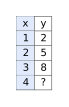
  8. Pattern table: What is the rule and the missing output?

    Ordered Pairs from Number Patterns visual for G5-C01-T09-Q009
    1. Multiply the input by 3, then subtract 1; output 11
    2. Add 1 to the input; output 5
    3. Double the input; output 8
    4. Multiply the input by 3; output 12
Teacher and parent reference

Answer key and explanations

  1. B. Multiply input by 4 and add 1; Output \(=21\)

    The output is 1 more than 4 times the input. For input 5, \(4 \times 5 + 1 = 21\).

  2. A. \((4, 12)\)

    The 4th input is 4 and the 4th output is 12. Put them in input-output order, so the ordered pair is \((4,12)\).

  3. A. \((0,3), (1,5), (2,7), (3,9)\)

    Check each input: double it, then add 3. For example, input 2 gives \(2 \times 2 + 3=7\).

  4. A. \((0,0), (3,6), (6,12), (9,18)\)

    P terms: 0, 3, 6, 9. Q terms: 0, 6, 12, 18.

  5. C. \((7, 13)\)

    To be in the pattern, the \(y\)-value must be double the \(x\)-value. For \((7,13)\), \(2 \times 7=14\), not 13, so that pair does not fit.

  6. C. \((4, 12)\)

    The rule says to multiply the input by 3. For input 4, \(3 \times 4=12\), so the ordered pair is \((4,12)\).

  7. B. \((5, 12)\)

    \(5 + 7 = 12\). Choice D is not correct because \(2+7=9\), not 8.

  8. A. Multiply the input by 3, then subtract 1; output 11

    Check the rows: \(3 \times 1-1=2\), \(3 \times 2-1=5\), \(3 \times 3-1=8\), and \(3 \times 4-1=11\).

Free Testinar sample Reviewed November 6, 2026 testinar.com
Page UP