Point P is at \((3, 2)\) on a coordinate plane. If point P is moved 2 units right and 3 units up, what are the new coordinates of P'?
- \(P'(5, 5)\)
- \(P'(1, 5)\)
- \(P'(5, 2)\)
- \(P'(3, 5)\)


Students will graph and interpret points in the first quadrant using ordered pairs.
Point P is at \((3, 2)\) on a coordinate plane. If point P is moved 2 units right and 3 units up, what are the new coordinates of P'?
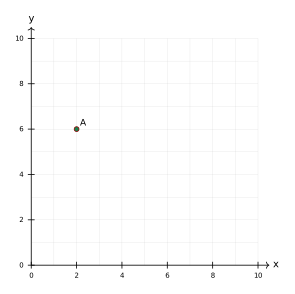
Which ordered pair names point A on the grid below?
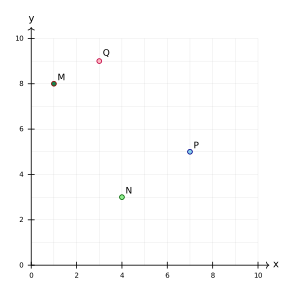
Which point is located at \((4, 3)\) on the coordinate plane?
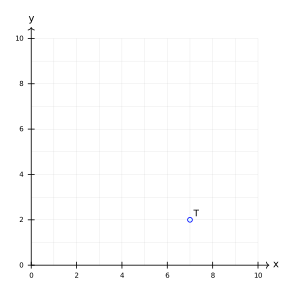
What are the coordinates of point T?
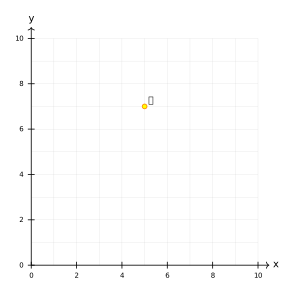
Which ordered pair best describes the location of the star on this grid?
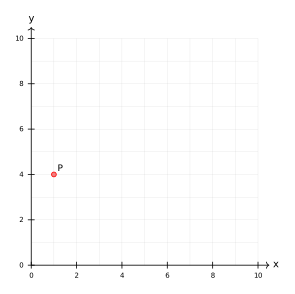
If you plot the point \((1, 4)\) on the coordinate plane, where will it be?
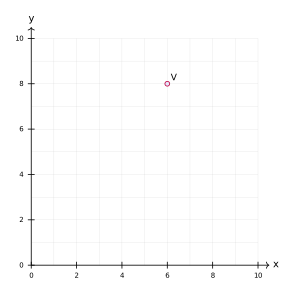
At what coordinates is point V located?
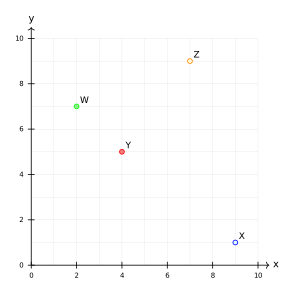
On this coordinate plane, which point is located at \((9, 1)\)?
Start with \(P(3,2)\). Moving 2 units right adds 2 to the x-coordinate, and moving 3 units up adds 3 to the y-coordinate, giving \(P'(5,5)\).
Point A is 2 units right along the \(x\)-axis and 6 units up along the \(y\)-axis, so the coordinates are \((2, 6)\).
Point N is 4 units right and 3 units up from the origin, placing it at \((4, 3)\).
Point T is located 7 units to the right and 2 units up, giving coordinates \((7, 2)\).
The star is 5 units to the right along the \(x\)-axis and 7 units up along the \(y\)-axis, so the coordinates are \((5, 7)\).
The \(x\)-coordinate of 1 means 1 unit to the right; the \(y\)-coordinate of 4 means 4 units up.
Point V is positioned 6 units right and 8 units up from the origin, giving the coordinates \((6, 8)\).
Point X is 9 units right and 1 unit up, matching the coordinates \((9, 1)\).
