Which expression represents four groups of the quantity \((6+2)\)?
- \(4 \times (6 + 2)\)
- \((4 \times 6) + 2\)
- \(4 + (6 \times 2)\)
- \((4 + 6) \times 2\)


Students will use variables and equations to represent unknown quantities in expressions.
Which expression represents four groups of the quantity \((6+2)\)?
Evaluate the expression: \((4 + 5) \times 2\)
Evaluate: \(20 - (3 \times 4)\)
Where should parentheses be placed to make the expression equal \(20\)? \(\)6 + 4 \times 2\(\)
Evaluate the expression: \(\)[\,2 + (3 \times 4)\,] \div 7\(\)
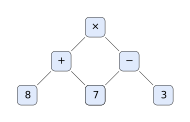
The expression tree shows how to evaluate the grouped expression \(((8+2)\times(7-3))\). What is the final value?
Evaluate: \(30 - \{\,4 + (2 \times 3)\,\}\)
Evaluate: \((15 \div 3) + 7\)
The words "four groups of the quantity \((6+2)\)" mean the grouped quantity is multiplied by 4. That is represented by \(4 \times (6+2)\).
Start with the part in parentheses: \(4 + 5 = 9\). Now multiply the result by 2: \(9 \times 2 = 18\). Nice careful grouping gives answer C.
The parentheses tell you what to do first. Since \(3 \times 4 = 12\), the expression becomes \(20 - 12\), which equals 8.
To make 20, group the addition first: \((6+4) \times 2 = 10 \times 2 = 20\). The other choices give different values, so A is the only match.
Work from the inside out. First \(3 \times 4 = 12\), then the bracket becomes \([2+12]=14\), and finally \(14 \div 7 = 2\).
The tree says to find each branch first: \(8+2=10\) and \(7-3=4\). Then multiply the two results: \(10 \times 4 = 40\).
Begin with the innermost operation: \(2 \times 3 = 6\). That makes the braces \(\{4+6\}=10\), so the full expression is \(30-10=20\).
The parentheses come first, so \(15 \div 3 = 5\). After that, add 7: \(5+7=12\).
