Which is larger: \(8\) or \(8 \times \frac{2}{3}\)?
- They are equal
- \(8\)
- \(8 \times \frac{2}{3}\)
- Cannot be determined


Students will interpret multiplication as scaling and compare the size of products.
Which is larger: \(8\) or \(8 \times \frac{2}{3}\)?
A recipe calls for \(6\) cups of flour. If you double the recipe, how much flour do you need?
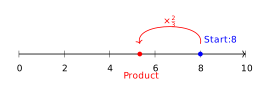
What is the value at the endpoint (product)?
A piece of fabric is \(12\) feet long. If you cut it to \(\frac{1}{4}\) of its original length, how long is the piece?
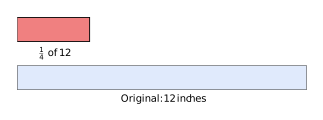
If the large bar represents \(12\) inches, what length does the colored part represent?
Which statement is true?
A cookie recipe makes \(20\) cookies. If you make \(\frac{1}{2}\) of the recipe, how many cookies will you make?
A ribbon is \(15\) inches long. You need to cut it to \(\frac{2}{5}\) of its length. How long will the cut piece be?
When you multiply by a fraction less than 1, the result is smaller. Since \(\frac{2}{3} < 1\), we have \(8 \times \frac{2}{3} < 8\). Therefore, \(8\) is larger.
Doubling means multiplying by \(2\). \(6 \times 2 = 12\) cups. Scaling by a factor greater than \(1\) increases the amount.
\(8 \times \frac{2}{3} = \frac{16}{3} = 5\frac{1}{3}\). The product is less than 8 because the scaling factor is less than 1.
\(12 \times \frac{1}{4} = 3\) feet. Multiplying by a fraction less than \(1\) shrinks the quantity.
The colored part is \(\frac{1}{4}\) of the whole bar. \(12 \times \frac{1}{4} = 3\) inches.
Multiplying by \(1\) keeps the value the same. Multiplying by \(\frac{3}{4}\) (less than \(1\)) makes it smaller: \(6 \times \frac{3}{4} = 4\frac{1}{2} < 6\).
Half of \(20\) is \(20 \times \frac{1}{2} = 10\) cookies. Scaling by \(\frac{1}{2}\) halves the amount.
\(15 \times \frac{2}{5} = \frac{30}{5} = 6\) inches. The product is smaller because the scaling factor is less than \(1\).
