What is \(4.7 \times 10\)?
- 0.47
- 4.7
- 47
- 470


Students will multiply decimals using powers of ten, models, and whole-number reasoning.
What is \(4.7 \times 10\)?
What is \(0.45 \times 10\)?
What is \(0.45 \times 100\)?
What is \(0.45 \times 1000\)?
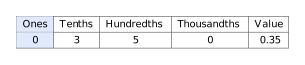
The place-value chart shows a number. When multiplied by 10, the digit 3 moves from the tenths place to which place?
What is \(2.13 \times 10\)?
Which expression equals 5.6?
What is \(0.08 \times 10\)?
Multiplying by 10 moves the decimal point 1 place to the right: \(4.7 \times 10 = 47\).
Multiplying by 10 moves the decimal point 1 place to the right: \(0.45 \times 10 = 4.5\).
Multiplying by 100 moves the decimal point 2 places to the right: \(0.45 \times 100 = 45\).
Multiplying by 1000 moves the decimal point 3 places to the right: \(0.45 \times 1000 = 450\).
Multiplying by 10 moves each digit one place to the left, so 3 moves from tenths to ones place.
Move the decimal point 1 place right: \(2.13 \times 10 = 21.3\).
\(0.56 \times 10 = 5.6\) (decimal moves 1 place right).
Move the decimal 1 place right: \(0.08 \times 10 = 0.8\).
