What is \(\frac{2}{3} \times \frac{1}{4}\)?
- \(\frac{2}{7}\)
- \(\frac{1}{12}\)
- \(\frac{2}{12}\) or \(\frac{1}{6}\)
- \(\frac{3}{4}\)


Students will multiply fractions by fractions using visual models and area reasoning.
What is \(\frac{2}{3} \times \frac{1}{4}\)?
Multiply: \(\frac{1}{2} \times \frac{1}{3}\)
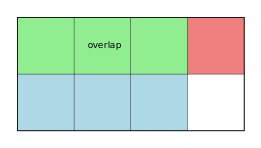
The area model below shows \(\frac{1}{2} \times \frac{3}{4}\). What fraction is shaded (overlap region)?
Multiply: \(\frac{2}{3} \times \frac{3}{4}\)
What is \(\frac{3}{4} \times \frac{2}{5}\) in simplest form?
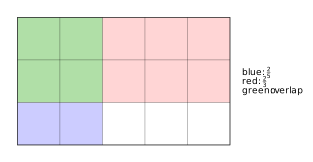
The shaded overlap represents \(\frac{2}{3} \times \frac{2}{5}\). What fraction of the whole rectangle is shaded?
Multiply \(\frac{2}{3} \times \frac{3}{4}\). Which choice shows the product in simplest form?
Multiply: \(\frac{1}{4} \times \frac{1}{5}\)
Multiply the numerators and denominators: \(\frac{2}{3}\times\frac{1}{4}=\frac{2}{12}\). Since both 2 and 12 can be divided by 2, the product simplifies to \(\frac{1}{6}\).
Multiply numerators and denominators: \(\frac{1 \times 1}{2 \times 3} = \frac{1}{6}\).
The rectangle is divided into 8 equal parts (4 columns \(\times\) 2 rows). The overlap covers 3 of those 8 parts, so \(\frac{1}{2}\times\frac{3}{4}=\frac{3}{8}\).
\(\frac{2}{3} \times \frac{3}{4} = \frac{2 \times 3}{3 \times 4} = \frac{6}{12}\), which simplifies to \(\frac{1}{2}\).
\(\frac{3}{4} \times \frac{2}{5} = \frac{6}{20} = \frac{3}{10}\) (divide by 2).
The rectangle has 15 cells (5 columns \(\times\) 3 rows). The shaded overlap region is 4 cells out of 15, so \(\frac{4}{15}\).
Multiply the numerators and denominators: \(\frac{2}{3}\times\frac{3}{4}=\frac{6}{12}\). Since 6 is half of 12, \(\frac{6}{12}=\frac{1}{2}\).
\(\frac{1}{4} \times \frac{1}{5} = \frac{1}{20}\) (multiply numerators and denominators).
