A runner jogs 5 laps. Each lap is \(\frac{3}{8}\) mile. How far does the runner jog in all?
- \(1\frac{1}{2}\) miles
- \(\frac{3}{8}\) mile
- \(2\frac{1}{8}\) miles
- \(1\frac{7}{8}\) miles


Students will multiply fractions by whole numbers using repeated addition, scaling, and models.
A runner jogs 5 laps. Each lap is \(\frac{3}{8}\) mile. How far does the runner jog in all?
What is \(3 \times \frac{1}{5}\)?
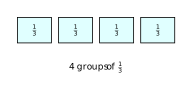
A bar model shows 4 copies of \(\frac{1}{3}\). What is \(4 \times \frac{1}{3}\)?
What is \(\frac{1}{6} \times 5\)?
A baker uses \(\frac{2}{3}\) cup of flour for one batch of cookies. How much flour is needed for 3 batches?
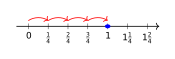
Number line with hops of \(\frac{1}{4}\): What is \(4 \times \frac{1}{4}\)?
Simplify: \(2 \times \frac{3}{8}\)
What is \(5 \times \frac{2}{7}\)?
Five laps means 5 copies of \(\frac{3}{8}\) mile. \(5 \times \frac{3}{8}=\frac{15}{8}=1\frac{7}{8}\) miles.
Think of 3 copies of one fifth. Multiply the whole number by the numerator: \(3 \times \frac{1}{5} = \frac{3 \times 1}{5} = \frac{3}{5}\).
The model shows 4 one-third pieces. That is \(4 \times \frac{1}{3} = \frac{4}{3}\), which is one whole and one more third, or \(1\frac{1}{3}\).
Five copies of \(\frac{1}{6}\) make \(\frac{5}{6}\). The denominator stays 6 because the size of each piece is still sixths.
Each batch needs \(\frac{2}{3}\) cup, and there are 3 batches. Multiply the 3 batches by the amount for one batch: \(3 \times \frac{2}{3} = \frac{6}{3} = 2\) cups.
The number line counts four equal hops of \(\frac{1}{4}\). After four fourths, you land on \(\frac{4}{4}=1\).
Two groups of \(\frac{3}{8}\) give \(\frac{6}{8}\). Since both 6 and 8 can be divided by 2, \(\frac{6}{8}=\frac{3}{4}\).
There are 5 groups of \(\frac{2}{7}\), so multiply \(5 \times 2\) in the numerator: \(5 \times \frac{2}{7}=\frac{10}{7}=1\frac{3}{7}\).
