How many zeros are in the product \(20 \times 50\)?
- 1
- 2
- 3
- 4


Students will use powers of ten to describe patterns in products, quotients, and decimal placement.
How many zeros are in the product \(20 \times 50\)?
What is \(30 \times 20\)? Use the zeros pattern to help.
How many zeros are in the product \(400 \times 60\)?
How many zeros are in the product of \(50 \times 80\)?
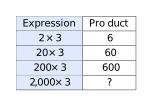
The pattern table shows products of \(2 \times 3\), \(20 \times 3\), etc. Complete the table.
How many zeros are in the product \(500 \times 800\)?
Which product has exactly 4 zeros?
How many zeros are in the product \(30 \times 30\)?
Think of \(20\) as \(2\) tens and \(50\) as \(5\) tens. Since \(2 \times 5=10\), the product becomes \(1{,}000\), which has 3 zeros.
First multiply the nonzero parts: \(3 \times 2=6\). The two factors each have one zero, so the product is \(600\).
Start with \(4 \times 6=24\). The factors \(400\) and \(60\) bring 3 zeros, giving \(24{,}000\). Since 24 does not end in zero, the product has 3 zeros.
The nonzero parts give \(5 \times 8=40\), which already ends in one zero. Then the two factor zeros make \(4{,}000\), so the product has 3 zeros.
The basic fact stays \(2 \times 3=6\). Since \(2{,}000\) has three zeros, the product is \(6{,}000\).
Use \(5 \times 8=40\), then include the four zeros from \(500\) and \(800\). That gives \(400{,}000\), which has 5 zeros.
\(20 \times 500\) is \(2 \times 5\) with four zeros altogether. Since \(2 \times 5=10\), the product is \(10{,}000\), which has 4 zeros.
The nonzero parts make \(3 \times 3=9\). The two factor zeros make the product \(900\), so it has 2 zeros.
