What is \(45 \times 7\)?
- 305
- 315
- 325
- 350


Students will use factor reasoning to identify prime and composite numbers.
What is \(45 \times 7\)?
What is \(24 \times 15\)?
A school orders 132 boxes of pencils. Each box has 24 pencils. How many pencils are ordered in all?
Estimate the product of \(23 \times 18\) by rounding each factor to the nearest ten, then multiply.
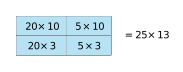
This area model shows \(25 \times 13\) broken into four partial products. What is the total product?
A school bought 12 boxes of colored pencils. Each box contains 24 pencils. How many pencils did the school buy?
What is \(31 \times 7\)?
A theater has 4 sections with 112 seats in each section. Which place-value sum can be used to find the total number of seats?
Break 45 into 40 and 5: \((40 \times 7) + (5 \times 7) = 280 + 35 = 315\).
Multiply: \(24 \times 15 = 24 \times (10+5) = 240 + 120 = 360\).
Multiply: \(132 \times 24 = 132 \times (20+4) = 2{,}640 + 528 = 3{,}168\).
Round 23 to 20 and 18 to 20. Then \(20 \times 20 = 400\).
Add the four partial products: \((20 \times 10) + (5 \times 10) + (20 \times 3) + (5 \times 3) = 200 + 50 + 60 + 15 = 325\).
Multiply: \(12 \times 24 = 12 \times (20 + 4) = (12 \times 20) + (12 \times 4) = 240 + 48 = 288\) pencils.
Multiply: \(31 \times 7 = (30 \times 7) + (1 \times 7) = 210 + 7 = 217\).
Use place value: \(112 \times 4 = (100 \times 4) + (10 \times 4) + (2 \times 4) = 400 + 40 + 8 = 448\) seats.
