Look at the shapes below. Which shape has two pairs of parallel sides, all sides the same length, and no right angles?
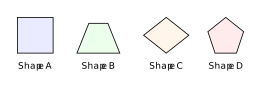
- Shape A
- Shape B
- Shape C
- Shape D


Students will identify properties of two-dimensional figures using sides, angles, and parallel lines.
Look at the shapes below. Which shape has two pairs of parallel sides, all sides the same length, and no right angles?
How many right angles does a rectangle have?
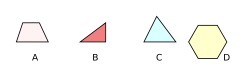
Which polygon is a regular polygon?
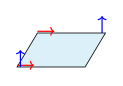
Look at the parallelogram below. How many pairs of parallel sides does it have?
Which marked non-square shape has all sides of equal length?
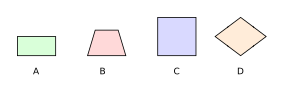
Which description identifies a quadrilateral that is not a parallelogram?
Which polygon has 8 sides and 8 vertices?
Use the markings in the figures. Which shape has no parallel sides and no right angles?
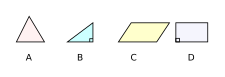
Shape C is a rhombus. It has two pairs of parallel sides, all sides the same length, and no right angles.
A rectangle has 4 right angles (one at each corner). All angles measure 90 degrees.
A regular polygon has all sides of equal length and all angles of equal measure. The hexagon (D) is regular.
A parallelogram has 2 pairs of parallel sides. The red arrows show one pair; the blue arrows show the other.
A square also has all sides equal, but the question asks for the non-square shape. The matching tick marks show the rhombus (D) has all four sides the same length, while its angles are not all right angles.
A figure with four sides is a quadrilateral. The phrase "exactly one pair of parallel sides" describes the needed attribute without relying on a state-specific trapezoid definition.
An octagon has 8 sides and 8 vertices. (A pentagon has 5, a hexagon has 6, a nonagon has 9.)
Figure A is a triangle with no parallel sides and no right angle. Figures B, C, and D do not match both conditions.
