CH02-04 lesson

Solving Multi-Step Word Problems with Whole Numbers Learning Activity

A focused Grade 5 learning session for Solving Multi-Step Word Problems with Whole Numbers using visual models, worked examples, strategy guidance, and a short mastery check.

18
minutes
6
lesson parts
11
practice items
Learning goal

Students will solve multi-step whole-number word problems and explain each operation choice.

Student goal: I can solve multi-step word problems with whole numbers.

concept

Learn the Idea

Solving Multi-Step Word Problems with Whole Numbers is the Grade 5 skill of students solve multi-step real-world problems using multiplication and division of whole numbers. They interpret remainders in context and determine whether to round up, round down, or use the remainder as the answer.


What do the numbers represent, and what strategy shows the idea clearly?

Strong understanding comes from naming what the numbers, shapes, units, or data values represent, then showing the idea with a model or clear steps before solving.

The key to this topic is understanding the structure behind the work, not just following a rule. Students should be able to talk through what is happening, point to a model, and explain why the answer makes sense.

  • Identify what each number, unit, or symbol means before solving.
  • Choose a model or strategy that makes the relationship visible.
  • Explain why the answer fits the situation instead of stopping at computation.
  • Use the topic language from class discussions: Students solve multi-step real-world problems using multiplication and division of whole numbers. They interpret remainders in context and determine whether to round up, round down, or use the remainder as the answer.
visual model

See the Math

Visual Model 1

Question: Marcus is saving money to buy a bicycle that costs \(285. He already has \)147. His grandmother gives him \(25 each week for doing chores. If Marcus also earns \)12 from selling lemonade every weekend, how many weeks will it take him to have enough money to buy the bicycle?

Grade 5 Solving Multi-Step Word Problems with Whole Numbers figure 1

  • A. 3 weeks
  • B. 4 weeks
  • C. 5 weeks
  • D. 6 weeks

How the model helps: Marcus needs \(285 - 147 = 138\) additional dollars. Each week he earns $\(25 + \)12 = \(37\). Dividing: \(138 \div 37 \approx 3.73\), so he needs 4 full weeks. Check: \(147 + 4 \times 37 = 295 \geq 285\).

worked example

Follow a Worked Example

Example 1

Question: A library fundraiser collected three donations: $\(284.75\), $\(156.50\), and $\(320.25\). The library spends $\(450.00\) on new books. How much money is left?

Grade 5 Solving Multi-Step Word Problems with Whole Numbers figure 2

  • $301.50
  • $761.50
  • $321.50
  • $311.50
  1. Add the donations: \(284.75+156.50+320.25=761.50\).
  2. Then subtract the cost of the books: \(761.50-450.00=311.50\).

Answer: $311.50

Example 2

Question: A runner completes a 5-mile course in 4 segments: 1.2 miles, 1.3 miles, 1.1 miles, and the final segment. How long is the final segment?

Grade 5 Solving Multi-Step Word Problems with Whole Numbers figure 3

  • A. 1.2 miles
  • B. 1.3 miles
  • C. 1.4 miles
  • D. 1.5 miles
  1. Total is 5 miles.
  2. Sum of known segments: \(1.2 + 1.3 + 1.1 = 3.6\) miles.
  3. Final segment: \(5 - 3.6 = 1.4\) miles.

Answer: 1.4 miles

real world

Connect It to a Real Situation

Problem 1

Question: A classroom has 156 pencils. Ms. Chen distributes them equally among 12 students. How many pencils does each student get?

  • A. 11 pencils
  • B. 12 pencils
  • C. 13 pencils
  • D. 14 pencils

Answer: 13 pencils

Why it works: Divide total pencils by number of students: \(156 \div 12 = 13\) pencils per student.

strategy

Avoid Mistakes and Choose a Strategy

  • Starting the computation before identifying what the numbers, units, or parts represent.
  • Skipping the model or visual and relying only on a memorized rule.
  • Forgetting to estimate, which makes it easier to miss an unreasonable answer.
  • Stopping at a number without explaining what the answer means in context.
  • Read the situation slowly and name what each number or label represents.
  • Use a model, table, chart, number line, or sketch before finishing the computation.
  • Estimate first so you already know the answer's approximate size.
  • Check the answer with an inverse operation, another representation, or a sentence explanation.
  • Say the math idea out loud in simple words before writing the final answer.
summary

Remember the Key Idea

Solving Multi-Step Word Problems with Whole Numbers gets easier when students read the model, track what each number means, and explain why the answer fits the situation.

GOLDEN RULE

Understand the structure first, then solve, check, and explain why the answer makes sense.

Guided to independent practice

Solve before opening the answer

Use scratch paper. The explanation matters more than simply seeing whether the choice is correct.

warmup

2 questions
G5-C02-T10-Q001 About 1 min

What is \(45 \times 7\)?

  1. A 305
  2. B 315
  3. C 325
  4. D 350
Check answer and explanation

Answer B: 315

Break 45 into 40 and 5: \((40 \times 7) + (5 \times 7) = 280 + 35 = 315\).

G5-C02-T10-Q002 About 1 min

What is \(24 \times 15\)?

  1. A 260
  2. B 320
  3. C 360
  4. D 460
Check answer and explanation

Answer C: 360

Multiply: \(24 \times 15 = 24 \times (10+5) = 240 + 120 = 360\).

guided

1 question
G5-C02-T10-Q003 About 1 min

A school orders 132 boxes of pencils. Each box has 24 pencils. How many pencils are ordered in all?

  1. A 2,968
  2. B 31,680
  3. C 3,248
  4. D 3,168
Check answer and explanation

Answer D: 3,168

Multiply: \(132 \times 24 = 132 \times (20+4) = 2{,}640 + 528 = 3{,}168\).

practice

5 questions
G5-C02-T10-Q004 About 1 min

Estimate the product of \(23 \times 18\) by rounding each factor to the nearest ten, then multiply.

  1. A 360
  2. B 380
  3. C 420
  4. D 400
Check answer and explanation

Answer D: 400

Round 23 to 20 and 18 to 20. Then \(20 \times 20 = 400\).

G5-C02-T10-Q005 About 1 min

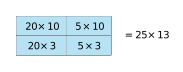
This area model shows \(25 \times 13\) broken into four partial products. What is the total product?

Multi-Digit Whole-Number Multiplication visual for G5-C02-T10-Q005
  1. A 315
  2. B 325
  3. C 335
  4. D 345
Check answer and explanation

Answer B: 325

Add the four partial products: \((20 \times 10) + (5 \times 10) + (20 \times 3) + (5 \times 3) = 200 + 50 + 60 + 15 = 325\).

G5-C02-T10-Q006 About 1 min

A school bought 12 boxes of colored pencils. Each box contains 24 pencils. How many pencils did the school buy?

  1. A 276
  2. B 288
  3. C 300
  4. D 312
Check answer and explanation

Answer B: 288

Multiply: \(12 \times 24 = 12 \times (20 + 4) = (12 \times 20) + (12 \times 4) = 240 + 48 = 288\) pencils.

G5-C02-T10-Q007 About 1 min

What is \(31 \times 7\)?

  1. A 210
  2. B 231
  3. C 224
  4. D 217
Check answer and explanation

Answer D: 217

Multiply: \(31 \times 7 = (30 \times 7) + (1 \times 7) = 210 + 7 = 217\).

G5-C02-T10-Q008 About 1 min
Multi-Digit Whole-Number Multiplication visual for G5-C02-T10-Q008
  1. A Student A is correct.
  2. B Student B is correct.
  3. C Both are correct.
  4. D Neither is correct.
Check answer and explanation

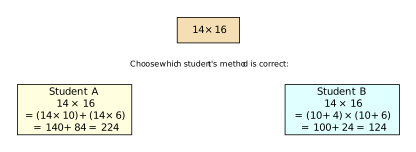
Answer A: Student A is correct.

Student A correctly applies the distributive property: \(14 \times 16 = 14 \times (10 + 6) = 140 + 84 = 224\). Student B made an error; the correct product is 224, not 124.

exit

3 questions
G5-C02-T10-Q009 About 1 min

A theater has 4 sections with 112 seats in each section. Which place-value sum can be used to find the total number of seats?

  1. A \(400+40+8\)
  2. B \(400+10+8\)
  3. C \(100+40+8\)
  4. D \(400+40+2\)
Check answer and explanation

Answer A: \(400+40+8\)

Use place value: \(112 \times 4 = (100 \times 4) + (10 \times 4) + (2 \times 4) = 400 + 40 + 8 = 448\) seats.

G5-C02-T10-Q010 About 1 min

A farmer plants corn in rows. There are 15 rows, and each row has 23 corn plants. How many corn plants does the farmer have?

  1. A 335
  2. B 345
  3. C 355
  4. D 365
Check answer and explanation

Answer B: 345

Multiply: \(15 \times 23 = 15 \times (20 + 3) = (15 \times 20) + (15 \times 3) = 300 + 45 = 345\) plants.

G5-C02-T10-Q011 About 1 min

What is \(43 \times 6\)?

  1. A 248
  2. B 278
  3. C 268
  4. D 258
Check answer and explanation

Answer D: 258

Multiply: \(43 \times 6 = (40 \times 6) + (3 \times 6) = 240 + 18 = 258\).

Page UP