Nora starts at (1, 2). She adds 2 to the \(x\)-coordinate and 3 to the \(y\)-coordinate to get her next point. If she continues this pattern, what will be her fourth point?
- (8, 14)
- (6, 10)
- (7, 11)
- (5, 8)


Students will solve real-world and mathematical problems on the coordinate plane.
Nora starts at (1, 2). She adds 2 to the \(x\)-coordinate and 3 to the \(y\)-coordinate to get her next point. If she continues this pattern, what will be her fourth point?
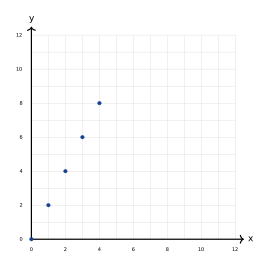
Rule A: Start at 0, add 1 each time. Rule B: Start at 0, add 2 each time. The first five points are shown. Which ordered pair should be plotted next?
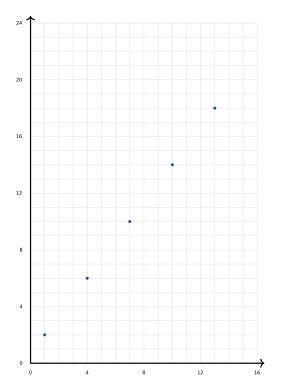
Marcus uses two number patterns. One rule adds 3 starting at 1. Another rule adds 4 starting at 2. What is the fifth ordered pair (first rule value, second rule value)?
Use Pattern A values as \(x\)-values and Pattern B values as \(y\)-values. Pattern A adds 5 starting at 0, and Pattern B adds 2 starting at 0. Which list shows the ordered pairs?
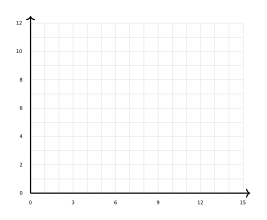
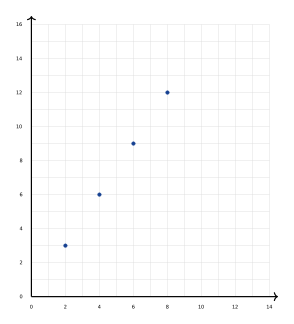
Omar plots (2, 3), (4, 6), (6, 9), (8, 12). Looking at his pattern, what should be the next point?
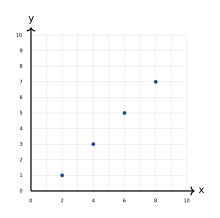
A recipe uses two ingredients. The first ingredient follows: 2, 4, 6, 8. The second follows: 1, 3, 5, 7. Which point is the third pair in the pattern?
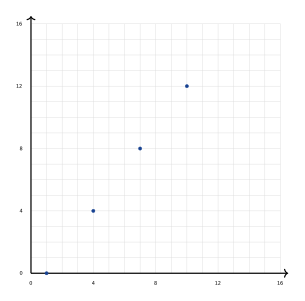
Rule A starts at 1 and adds 3. Rule B starts at 0 and adds 4. Which list gives the first four ordered pairs as (Rule A, Rule B)?
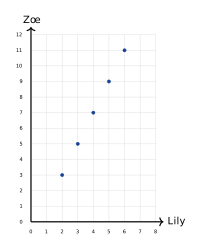
Lily starts with 2 and adds 1 each time (first sequence). Zoe starts with 3 and adds 2 each time (second sequence). Which point does NOT match the plotted pattern of (Lily, Zoe)?
Following the pattern: point 1 is (1, 2), point 2 is (3, 5), point 3 is (5, 8), point 4 is (7, 11).
The next Rule A value is 5 and the next Rule B value is 10, so the next ordered pair is \((5,10)\).
Rule 1: 1, 4, 7, 10, 13. Rule 2: 2, 6, 10, 14, 18. Fifth pair is (13, 18).
Pattern A gives the \(x\)-values \(0, 5, 10,\ldots\) and Pattern B gives the \(y\)-values \(0, 2, 4,\ldots\). The ordered pairs are \((0,0)\), \((5,2)\), and \((10,4)\).
Each time \(x\) increases by 2, \(y\) increases by 3. From (8, 12): \(x\) becomes 10, \(y\) becomes 15.
Pairs are (2,1), (4,3), (6,5), (8,7). The third pair is (6, 5).
Rule A: 1, 4, 7, 10. Rule B: 0, 4, 8, 12. Pairs (Rule A, Rule B) are listed in choice A.
Lily: 2, 3, 4, 5, 6. Zoe: 3, 5, 7, 9, 11. Point (5, 10) doesn't match—it should be (5, 9).
