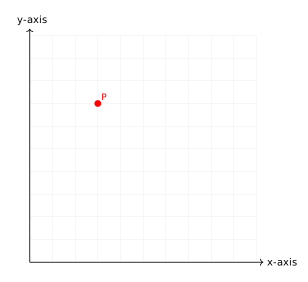
What ordered pair represents the location of the point marked on the grid?
- \((7, 3)\)
- \((7, 7)\)
- \((3, 3)\)
- \((3, 7)\)


Students will understand the coordinate plane, axes, origin, and ordered pairs.
What ordered pair represents the location of the point marked on the grid?
Where is the origin on a coordinate grid?
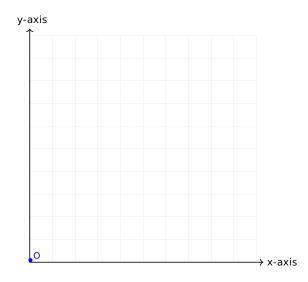
What is the ordered pair of the origin?
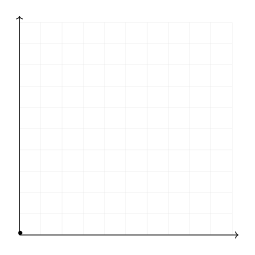
Which point lies on the x-axis?
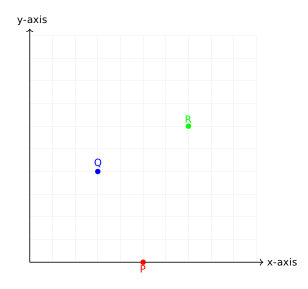
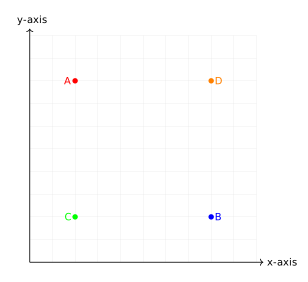
Which point is at \((2, 8)\)?
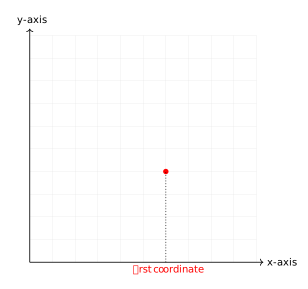
What is the x-coordinate of the point at \((6, 4)\)?
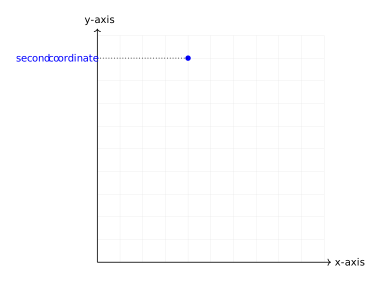
What is the y-coordinate of the point at \((4, 9)\)?
How many units right must you go from the origin to reach the point \((5, 2)\)?
An ordered pair \((x, y)\) shows the location of a point. The x-coordinate (3) tells how far right from the origin, and the y-coordinate (7) tells how far up. The point is at \((3, 7)\).
The origin is the point where the x-axis and y-axis intersect, labeled as \((0, 0)\).
The origin is located at \((0, 0)\), where both coordinates are zero.
Point P at \((5, 0)\) has a y-coordinate of 0, so it lies on the x-axis.
Point A is located 2 units right (x-coordinate) and 8 units up (y-coordinate), so it is at \((2, 8)\).
In an ordered pair \((x, y)\), the first number is the x-coordinate. For \((6, 4)\), the x-coordinate is \(6\).
In an ordered pair \((x, y)\), the second number is the y-coordinate. For \((4, 9)\), the y-coordinate is \(9\).
The x-coordinate tells how many units right from the origin. For \((5, 2)\), move \(5\) units right.
