A parallelogram has a base of \(8\) m and a height of \(5\) m. What is its area?
- \(13\) m\(^2\)
- \(26\) m\(^2\)
- \(40\) m\(^2\)
- \(80\) m\(^2\)


Students will build Grade 6 mastery of area of parallelograms and trapezoids using models, equations, and test-style reasoning.
A parallelogram has a base of \(8\) m and a height of \(5\) m. What is its area?
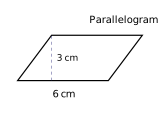
What is the area of the parallelogram?
A trapezoid has bases of \(7\) m and \(9\) m with a height of \(4\) m. What is its area?
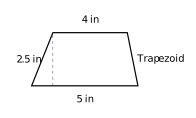
Which measurement is the height of the trapezoid?
A parallelogram has a base of \(12\) cm and an area of \(60\) cm\(^2\). What is its height?
A trapezoid has an area of \(48\) m\(^2\) and a height of \(6\) m. One base is \(5\) m long. What is the length of the other base?
A parking lot is shaped like a parallelogram with a base of \(40\) m and a height of \(15\) m. What is the area of the parking lot?
A garden bed is shaped like a trapezoid with parallel sides of \(8\) ft and \(12\) ft and a height of \(6\) ft. How many square feet is the garden bed?
Area of a parallelogram \(=\) base \(\times\) height \(=8\times5=40\) m\(^2\).
The labeled height is \(3\) cm (the perpendicular distance) and the base is \(6\) cm. Area \(=6 \times 3 = 18\) cm\(^2\).
Area of a trapezoid \(= \frac{1}{2}(b_1 + b_2) \times h = \frac{1}{2}(7 + 9) \times 4 = \frac{1}{2} \times 16 \times 4 = 32\) m\(^2\).
The height is the perpendicular distance between the two parallel bases, shown by the dashed line, which is \(2.5\) in.
Area \(= b \times h\), so \(60 = 12 \times h\). Dividing both sides by \(12\): \(h = 5\) cm.
Using \(A = \frac{1}{2}(b_1 + b_2) \times h\): \(48 = \frac{1}{2}(5 + b_2) \times 6 = 3(5 + b_2) = 15 + 3b_2\), so \(3b_2 = 33\) and \(b_2 = 11\) m.
Area of the parallelogram \(= 40 \times 15 = 600\) m\(^2\).
Area of trapezoid \(= \frac{1}{2}(8 + 12) \times 6 = \frac{1}{2}(20)(6) = 60\) ft\(^2\).
