

CH02-03 lesson

Decimal Operations Learning Activity

A focused Grade 6 learning session for Decimal Operations using visual models, worked examples, strategy guidance, and a short mastery check.

15
minutes
6
lesson parts
11
practice items
Learning goal

Students will build Grade 6 mastery of decimal operations using models, equations, and test-style reasoning.

Student goal: I can solve problems involving decimal operations.

Helpful first: Multi-Digit Division
concept

Learn the Idea

Decimal Operations means choosing a model, naming what each number means, and explaining the strategy.

  • Read the question carefully and identify what is being asked.
  • Choose a model, equation, table, or diagram that matches the situation.
  • Solve one step at a time and keep units or labels attached.
  • Use the answer explanation to check that the result makes sense.
visual model

See the Math

Visual Model 1

Question: The place-value chart shows a decimal. What is the digit in the hundredths place?

OnesTenthsHundredthsThousandths
\(3\)\(2\)\(7\)\(5\)
  • A. \(3\)
  • B. \(2\)
  • C. \(7\)
  • D. \(5\)

Why it works: Reading the chart: the digit in the hundredths place is in the third column, which is \(7\).

Answer: \(7\)
worked example

Follow a Worked Example

Example 1

Question: Place-value chart of a decimal is shown. What is the number in standard form?

OnesTenthsHundredths
\(5\)\(4\)\(8\)
  • A. \(548\)
  • B. \(0.548\)
  • C. \(54.8\)
  • D. \(5.48\)
  1. Reading the chart: \(5\) ones, \(4\) tenths, \(8\) hundredths gives \(5.48\).

Answer: \(5.48\)

Example 2

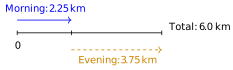
Question: A jogger runs \(2.25\) km in the morning and \(3.75\) km in the evening. What is the total distance?

Example 2

  • A. \(6.0\) km
  • B. \(5.75\) km
  • C. \(6.5\) km
  • D. \(5.0\) km
  1. Add: \(2.25 + 3.75 = 6.0\) km.

Answer: \(6.0\) km

real world

Connect It to a Real Situation

Problem 1

Question: A recipe calls for \(3.5\) cups of flour. If you are making double the recipe, how much flour do you need?

  • A. \(1.75\) cups
  • B. \(5.5\) cups
  • C. \(7\) cups
  • D. \(7.5\) cups

Why it works: Double means multiply by \(2\): \(3.5 \times 2 = 7\) cups.

Answer: \(7\) cups

strategy

Avoid Mistakes and Choose a Strategy

  • Rushing before identifying what the numbers represent.
  • Choosing an operation that does not match the situation.
  • Dropping labels, units, or context from the answer.
  • Skipping the estimate or reasonableness check.
  • Underline the question being asked.
  • Use a model before jumping to computation.
  • Write an equation that matches the story or picture.
  • Explain the final answer in a sentence.
summary

Remember the Key Idea

Decimal Operations becomes easier when students connect the question to a model, use clear steps, and explain why the answer fits.

GOLDEN RULE

Understand the model before choosing the operation.

Guided to independent practice

Solve before opening the answer

Use scratch paper. The explanation matters more than simply seeing whether the choice is correct.

warmup

2 questions
G6-C02-T03-Q001 About 1 min

What is \(4.6\times0.8\)?

  1. A \(3.68\)
  2. B \(36.8\)
  3. C \(0.368\)
  4. D \(5.4\)
Check answer and explanation

Answer A: \(3.68\)

Treat it like whole numbers first: \(46\times8=368\). Together the factors tuck in two decimal places, so the "real" answer is cozy at \(3.68\).

G6-C02-T03-Q002 About 1 min

Compute: \(12.7+8.45\)

  1. A \(20.112\)
  2. B \(4.25\)
  3. C \(21.52\)
  4. D \(21.15\)
Check answer and explanation

Answer D: \(21.15\)

Align decimal points: \(12.70 + 8.45 = 21.15\). Stack and add, carrying as needed.

guided

1 question
G6-C02-T03-Q003 About 1 min

What is \(25.6 - 13.8\)?

  1. A \(11.8\)
  2. B \(12.2\)
  3. C \(38.4\)
  4. D \(39.4\)
Check answer and explanation

Answer A: \(11.8\)

Align the decimal points. In the tenths place, \(6\) is smaller than \(8\), so regroup one whole as ten tenths: the \(5\) becomes \(4\) and the tenths become \(16\). Then \(16 - 8 = 8\) tenths, \(4 - 3 = 1\) one, and \(2 - 1 = 1\) ten, so the result is \(11.8\).

practice

5 questions
G6-C02-T03-Q004 About 1 min

Estimate the product: \(7.9 \times 4.2\). Which is closest?

  1. A \(32\)
  2. B \(12\)
  3. C \(28\)
  4. D \(40\)
Check answer and explanation

Answer A: \(32\)

Roughly, \(8 \times 4 = 32\) since \(7.9\) is near \(8\) and \(4.2\) is near \(4\). That ballpark is what estimation is for---save the exact digits for when you need them.

G6-C02-T03-Q005 About 1 min

A receipt shows three items: $5.25, $12.99, and $8.50. What is the total?

  1. A $26.74
  2. B $25.74
  3. C $27.00
  4. D $18.24
Check answer and explanation

Answer A: $26.74

Add: $5.25 + $12.99 + $8.50 = $26.74. Align decimal points for money.

G6-C02-T03-Q006 About 1 min

Divide: \(18.4 \div 4\)

  1. A \(4.6\)
  2. B \(46\)
  3. C \(4.06\)
  4. D \(14.4\)
Check answer and explanation

Answer A: \(4.6\)

Sharing \(18.4\) across four equal groups yields \(4.6\). Multiply back cheerfully: \(4 \times 4.6 = 18.4\) feels just right.

G6-C02-T03-Q007 About 1 min

Which multiplication has the decimal point in the correct place?

  1. A \(2.3 \times 5.1 = 117.3\)
  2. B \(2.3 \times 5.1 = 1173\)
  3. C \(2.3 \times 5.1 = 11.73\)
  4. D \(2.3 \times 5.1 = 1.173\)
Check answer and explanation

Answer C: \(2.3 \times 5.1 = 11.73\)

\(23 \times 51 = 1173\). We have \(1 + 1 = 2\) decimal places total, so \(11.73\) is correct.

G6-C02-T03-Q008 About 1 min

A recipe calls for \(3.5\) cups of flour. If you are making double the recipe, how much flour do you need?

  1. A \(1.75\) cups
  2. B \(5.5\) cups
  3. C \(7\) cups
  4. D \(7.5\) cups
Check answer and explanation

Answer C: \(7\) cups

Double means multiply by \(2\): \(3.5 \times 2 = 7\) cups.

exit

3 questions
G6-C02-T03-Q009 About 1 min

Find the sum: \(0.75 + 1.4 + 2.1\)

  1. A \(3.15\)
  2. B \(4.25\)
  3. C \(4.35\)
  4. D \(4.15\)
Check answer and explanation

Answer B: \(4.25\)

Add: \(0.75 + 1.40 + 2.10 = 4.25\). Align all decimal points first.

G6-C02-T03-Q010 About 1 min

What is \(0.06 \times 0.8\)?

  1. A \(0.048\)
  2. B \(0.48\)
  3. C \(4.8\)
  4. D \(48\)
Check answer and explanation

Answer A: \(0.048\)

\(6 \times 8 = 48\). We have \(2 + 1 = 3\) decimal places total, so \(0.048\) is correct.

G6-C02-T03-Q011 About 1 min

A pencil is \(0.15\) meters long. A pen is \(0.08\) meters long. How much longer is the pencil?

  1. A \(0.07\) meters
  2. B \(0.23\) meters
  3. C \(0.07\) cm
  4. D \(1.87\) meters
Check answer and explanation

Answer A: \(0.07\) meters

Subtract: \(0.15 - 0.08 = 0.07\) meters. Align decimal points.

Page UP