What is \(\frac{3}{4}\div\frac{1}{2}\)?
- \(\frac{3}{8}\)
- \(\frac{2}{3}\)
- \(1\frac{1}{2}\)
- \(2\)


Students will build Grade 6 mastery of dividing fractions by fractions using models, equations, and test-style reasoning.
Choose a free PDF. Each has different questions and worked solutions. The preview shows the student question page; open the PDF to read or print it at full size.
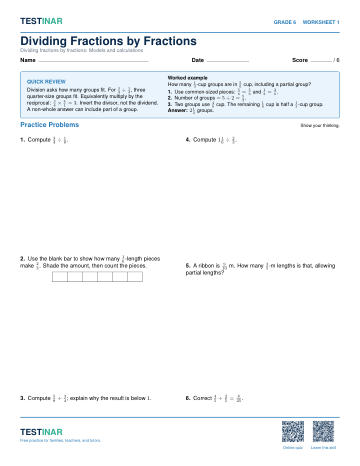 Worksheet 1
6 problems
Models and calculations.
Open PDF
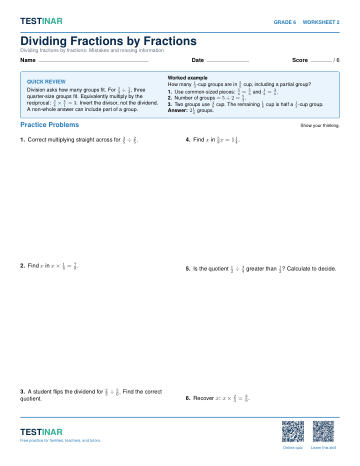 Worksheet 2
6 problems
Mistakes and missing information.
Open PDF
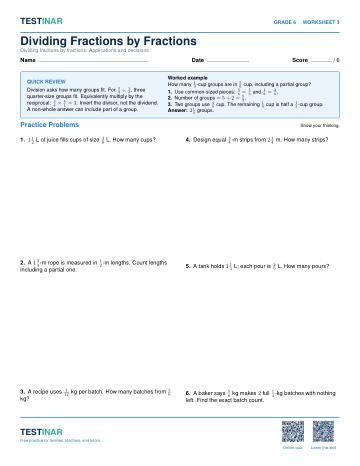 Worksheet 3
6 problems
Applications and decisions.
Open PDF
Print page 1 for students. Page 2 has the solutions; page 3 has optional book recommendations.
These online questions are separate from the three PDF worksheets above.
What is \(\frac{3}{4}\div\frac{1}{2}\)?
Evaluate: \(\frac{5}{6}\div\frac{1}{3}\)
What is \(\frac{2}{3}\div\frac{4}{5}\)?
Compute: \(\frac{7}{8}\div\frac{1}{4}\)
A recipe calls for \(\frac{3}{4}\) cup of sugar. If you want to make exactly half of the recipe (so that every ingredient is halved), how much sugar do you need? Which expression represents this situation?
What is \(\frac{4}{5}\div\frac{2}{3}\)?
How many \(\frac{1}{4}\)-cup servings are in \(2\) cups?
A trail is \(3\frac{1}{2}\) miles long. How many \(\frac{3}{4}\)-mile lengths fit along the trail?
Friendly reminder: when you divide by a fraction, you can multiply by its reciprocal (“flip” the divisor and multiply). \(\frac{3}{4}\div\frac{1}{2}=\frac{3}{4}\times\frac{2}{1}=\frac{6}{4}\), which simplifies to \(\frac{3}{2}\), or \(1\frac{1}{2}\).
Rewrite the division as multiplication by flipping \(\frac{1}{3}\): \(\frac{5}{6}\times\frac{3}{1}=\frac{15}{6}\). Simplify \(\frac{15}{6}\) to \(\frac{5}{2}\) (or mixed form \(2\frac{1}{2}\)).
Invert \(\frac{4}{5}\) to \(\frac{5}{4}\), then multiply: \(\frac{2}{3}\times\frac{5}{4}=\frac{10}{12}\). That reduces nicely to \(\frac{5}{6}\).
\(\frac{7}{8}\times\frac{4}{1}=\frac{28}{8}=\frac{7}{2}=3\frac{1}{2}\).
"Half the recipe" means multiply each ingredient by \(\frac{1}{2}\), not divide by \(\frac{1}{2}\). So you want \(\frac{3}{4}\times\frac{1}{2}=\frac{3}{8}\) cup of sugar.
\(\frac{4}{5}\times\frac{3}{2}=\frac{12}{10}=\frac{6}{5}\).
You are counting how many \(\frac{1}{4}\)-cup servings fit inside \(2\) cups---that’s a division problem: \(2\div\frac{1}{4}\). Rewrite as \(2\times 4\), which equals \(8\) servings.
Change \(3\frac{1}{2}\) to \(\frac{7}{2}\), then divide by multiplying by \(\frac{4}{3}\): \(\frac{7}{2}\times\frac{4}{3}=\frac{28}{6}\), which simplifies to \(\frac{14}{3}\) or \(4\frac{2}{3}\) lengths along the trail.
