Testinar Grade 6 math

Financial Literacy — Budgeting and Saving

Students will build Grade 6 mastery of financial literacy - budgeting and saving using models, equations, and test-style reasoning.

CH01-13 Ratios, Rates, and Percents
Name
Date
Score
____ / 8
Directions Solve each problem. Show your reasoning on the page or on separate paper. Check the answer key only after finishing.
  1. Marcus earns \($250\) per week mowing lawns. He budgets \(40\%\) for expenses, \(25\%\) for savings, and the rest for spending. How much does he save each week?

    1. \($100\) (40% spent)
    2. \($95\) (35% remaining)
    3. \($62.50\) (25% saved)
    4. \($35\) (14% miscalc.)
  2. Sophia receives \($120\) allowance per month. She spends \(30\%\) on music lessons. How much does she spend on music lessons?

    1. \($36\) (30% correct)
    2. \($24\) (20% wrong %)
    3. \($84\) (70% complement)
    4. \($40\) (wrong % base)
  3. A student saves \($15\) out of every \($100\) earned. What percentage of earnings does the student save?

    1. \(6\%\)
    2. \(15\%\)
    3. \(25\%\)
    4. \(85\%\)
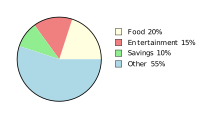
  4. Tyrone earns \($80\) per week. His budget allocates \(20\%\) for food, \(15\%\) for entertainment, and \(10\%\) for savings. How much does he spend on food?

    Financial Literacy — Budgeting and Saving visual for G6-C01-T13-Q004
    1. \($16\)
    2. \($12\)
    3. \($8\)
    4. \($20\)
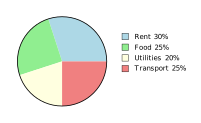
  5. Aisha's monthly budget is shown in the pie chart above. If her monthly income is \($2000\), how much does she allocate to rent?

    Financial Literacy — Budgeting and Saving visual for G6-C01-T13-Q005
    1. \($400\)
    2. \($500\)
    3. \($600\)
    4. \($700\)
  6. From the pie chart above, how much does Aisha allocate to food and utilities combined?

    1. \($400\)
    2. \($600\)
    3. \($800\)
    4. \($900\)
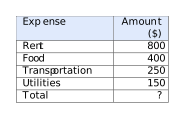
  7. A family's monthly expenses are: Rent \($800\), Utilities \($150\), Food \($400\), and Transportation \($250\). What is their total monthly expense?

    Financial Literacy — Budgeting and Saving visual for G6-C01-T13-Q007
    1. \($1400\)
    2. \($1550\)
    3. \($1600\)
    4. \($1800\)
  8. A family budgets \($1500\) per month but has actual expenses of \($1700\). What is the shortfall (amount over budget)?

    1. \($100\)
    2. \($200\)
    3. \($300\)
    4. \($400\)
Teacher and parent reference

Answer key and explanations

  1. C. \($62.50\) (25% saved)

    Savings are \(25\%\) of \($250\): \(0.25 \times 250 = $62.50\).

  2. A. \($36\) (30% correct)

    Calculate \(30\%\) of \($120\): \(0.30 \times 120 = $36\).

  3. B. \(15\%\)

    The ratio is \(\frac{15}{100} = 0.15 = 15\%\).

  4. A. \($16\)

    Food budget is \(20\%\) of \($80\): \(0.20 \times 80 = $16\).

  5. C. \($600\)

    Rent is \(30\%\) of income: \(0.30 \times 2000 = $600\).

  6. D. \($900\)

    Food and utilities: \(25\% + 20\% = 45\%\) of \($2000 = 0.45 \times 2000 = $900\).

  7. C. \($1600\)

    Sum all expenses: \(800 + 150 + 400 + 250 = $1600\).

  8. B. \($200\)

    Shortfall is Expenses minus Budgeted Amount: \($1700 - $1500 = $200\).

Free Testinar sample Reviewed November 6, 2026 testinar.com
Page UP