Find the mean of the data set: \(4, 6, 8, 10, 12\).
- \(6\)
- \(8\)
- \(10\)
- \(40\)


Students will build Grade 6 mastery of mean and median using models, equations, and test-style reasoning.
Find the mean of the data set: \(4, 6, 8, 10, 12\).
What is the mean of the numbers \(2, 4, 6, 8, 10\)?
Find the mean of \(5, 15, 20, 30\).
What is the median of the data set: \(3, 7, 9, 12, 15\)?
Find the median of \(2, 5, 8, 11, 14, 17\).
The mean of \(5, 8, 12, x\) is \(10\). What is the value of \(x\)?
The data set is: \(2, 4, 6, 8, 30\). Which statement is true?
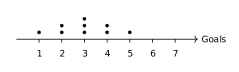
A dot plot shows the number of goals scored by 9 players: What is the median number of goals?
Mean \(=\frac{4+6+8+10+12}{5}=\frac{40}{5}=8\).
Mean \(=\frac{2+4+6+8+10}{5}=\frac{30}{5}=6\).
Mean \(=\frac{5+15+20+30}{4}=\frac{70}{4}=17.5\).
The data is already ordered. The median is the middle value: \(9\).
Median is the average of the two middle values (positions 3 and 4): \(\frac{8+11}{2}=9.5\).
Mean \(= \frac{5+8+12+x}{4}=10 \Rightarrow 5+8+12+x=40 \Rightarrow x=15\).
Mean \(=\frac{2+4+6+8+30}{5}=10\). Median \(=6\) (middle value). Since \(10>6\), the mean is greater than the median. The outlier \(30\) pulls the mean up.
Data: \(1, 2, 2, 3, 3, 3, 4, 4, 5\). The median (middle of 9 values) is the 5th value: \(3\).
