CH01-11 lesson

Personal Financial Literacy Learning Activity

A focused Grade 6 learning session for Personal Financial Literacy using visual models, worked examples, strategy guidance, and a short mastery check.

15
minutes
6
lesson parts
11
practice items
Learning goal

Students will build Grade 6 mastery of personal financial literacy using models, equations, and test-style reasoning.

Student goal: I can solve problems involving personal financial literacy.

concept

Learn the Idea

Personal Financial Literacy means choosing a model, naming what each number means, and explaining the strategy.

  • Read the question carefully and identify what is being asked.
  • Choose a model, equation, table, or diagram that matches the situation.
  • Solve one step at a time and keep units or labels attached.
  • Use the answer explanation to check that the result makes sense.
visual model

See the Math

Visual Model 1

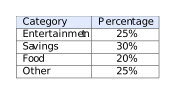
Question: The table below shows how Maria budgets her monthly allowance of \($80\). How much of her allowance does Maria allocate to Savings?

CategoryPercentage
Entertainment\(25%\)
Savings\(30%\)
Food\(20%\)
Other\(25%\)
  • A. \($24\)
  • B. \($20\)
  • C. \($16\)
  • D. \($30\)

Why it works: \(30\%\) of \($80\) is \(0.30 \times 80 = $24\).

Answer: \($24\)

worked example

Follow a Worked Example

Example 1

Question: The circle graph shows Ramon's monthly budget allocation (total income \($1000\)). How much does Ramon allocate to Entertainment?

Example 1

  • A. \($100\)
  • B. \($250\)
  • C. \($200\)
  • D. \($150\)
  1. Entertainment is \(15\%\) of the budget. \(15\%\) of \($1000 = 0.15 \times 1000 = $150\).

Answer: \($150\)

Example 2

Question: The receipt below shows items from a store with \(6\%\) sales tax. What is the sales tax on this purchase?

ItemPrice
Notebook$5.00
Pen pack$3.50
Folder$2.00
Subtotal$10.50
Tax (6%)?
Total?
  • A. \($0.42\)
  • B. \($0.63\)
  • C. \($0.78\)
  • D. \($1.05\)
  1. Sales tax: \(6\%\) of \($10.50 = 0.06 \times 10.50 = $0.63\).

Answer: \($0.63\)

real world

Connect It to a Real Situation

Problem 1

Question: David has assets worth \($1200\) (laptop, savings, bike). He has debts of \($300\) (money owed to parents). What is his net worth?

  • A. \($800\)
  • B. \($900\)
  • C. \($1000\)
  • D. \($1500\)

Why it works: Net worth = Assets \(-\) Debts \(= $1200 - $300 = $900\).

Answer: \($900\)

strategy

Avoid Mistakes and Choose a Strategy

  • Rushing before identifying what the numbers represent.
  • Choosing an operation that does not match the situation.
  • Dropping labels, units, or context from the answer.
  • Skipping the estimate or reasonableness check.
  • Underline the question being asked.
  • Use a model before jumping to computation.
  • Write an equation that matches the story or picture.
  • Explain the final answer in a sentence.
summary

Remember the Key Idea

Personal Financial Literacy becomes easier when students connect the question to a model, use clear steps, and explain why the answer fits.

GOLDEN RULE

Understand the model before choosing the operation.

Guided to independent practice

Solve before opening the answer

Use scratch paper. The explanation matters more than simply seeing whether the choice is correct.

warmup

2 questions
G6-C01-T11-Q001 About 1 min

Alina earns \($400\) each month. She saves \(15\%\) of her income for college. How much does she save each month?

  1. A \($15\)
  2. B \($40\)
  3. C \($60\)
  4. D \($85\)
Check answer and explanation

Answer C: \($60\)

\(15\%\) of \($400\) is \(0.15 \times 400 = $60\).

G6-C01-T11-Q002 About 1 min

Marcus earns \($250\) per week. He wants to save \(20\%\) of his earnings. How much will he save in one week?

  1. A \($20\)
  2. B \($100\)
  3. C \($70\)
  4. D \($50\)
Check answer and explanation

Answer D: \($50\)

\(20\%\) of \($250\) is \(0.20 \times 250 = $50\).

guided

1 question
G6-C01-T11-Q003 About 1 min

The table below shows how Maria budgets her monthly allowance of \($80\). How much of her allowance does Maria allocate to Savings?

Personal Financial Literacy visual for G6-C01-T11-Q003
  1. A \($24\)
  2. B \($20\)
  3. C \($16\)
  4. D \($30\)
Check answer and explanation

Answer A: \($24\)

\(30\%\) of \($80\) is \(0.30 \times 80 = $24\).

practice

5 questions
G6-C01-T11-Q004 About 1 min

Jordan receives \($120\) monthly as income. He spends \($45\) on lunch, \($30\) on entertainment, and \($20\) on transportation. How much does he have left?

  1. A \($20\)
  2. B \($25\)
  3. C \($35\)
  4. D \($40\)
Check answer and explanation

Answer B: \($25\)

Total expenses: \($45 + $30 + $20 = $95\). Remaining: \($120 - $95 = $25\).

G6-C01-T11-Q005 About 1 min

Sarah opens a savings account with \($500\) earning a simple interest rate of \(4\%\) per year. Using the formula \(I = P \times r \times t\), how much interest will she earn in \(2\) years?

  1. A \($20\)
  2. B \($100\)
  3. C \($80\)
  4. D \($40\)
Check answer and explanation

Answer D: \($40\)

\(I = $500 \times 0.04 \times 2 = $40\).

G6-C01-T11-Q006 About 1 min

Tanya earns \($600\) per month. Her fixed expenses are \($180\) for rent, \($60\) for utilities, and \($60\) for food. What percentage of her income goes to these fixed expenses?

  1. A \(30\%\)
  2. B \(40\%\)
  3. C \(50\%\)
  4. D \(60\%\)
Check answer and explanation

Answer C: \(50\%\)

Total fixed expenses: \($180 + $60 + $60 = $300\). Percentage of income: \(\frac{$300}{$600} = \frac{1}{2} = 50\%\).

G6-C01-T11-Q007 About 1 min

Keisha uses a debit card to purchase a video game for \($45\). What will happen to her bank account?

  1. A The bank lends her \($45\)
  2. B The balance decreases by \($45\)
  3. C She earns \($45\) in interest
  4. D The balance increases by \($45\)
Check answer and explanation

Answer B: The balance decreases by \($45\)

A debit card draws directly from her bank account, reducing the balance by the purchase amount. Credit cards defer payment (she borrows); interest is earned on savings, not debit purchases; and balances don't increase from purchases.

G6-C01-T11-Q008 About 1 min

David has assets worth \($1200\) (laptop, savings, bike). He has debts of \($300\) (money owed to parents). What is his net worth?

  1. A \($800\)
  2. B \($900\)
  3. C \($1000\)
  4. D \($1500\)
Check answer and explanation

Answer B: \($900\)

Net worth = Assets \(-\) Debts \(= $1200 - $300 = $900\).

exit

3 questions
G6-C01-T11-Q009 About 1 min

Emma wants to save for a bike that costs \($200\). She saves \($25\) per month. How many months will it take her to save enough for the bike?

  1. A \(6\) months
  2. B \(12\) months
  3. C \(10\) months
  4. D \(8\) months
Check answer and explanation

Answer D: \(8\) months

\(\frac{$200}{$25 \text{ per month}} = 8\) months.

G6-C01-T11-Q010 About 1 min

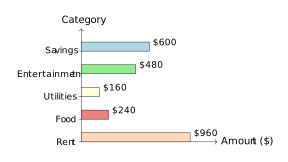
The bar chart below shows monthly household expenses for the Chen family (total income: \($2400\)). How much of the family's monthly income is spent on Food?

Personal Financial Literacy visual for G6-C01-T11-Q010
  1. A \($240\)
  2. B \($400\)
  3. C \($480\)
  4. D \($600\)
Check answer and explanation

Answer C: \($480\)

According to the bar chart, the Food category is labeled as \($480\).

G6-C01-T11-Q011 About 1 min

A jacket originally costs \($80\). The store is offering a \(25\%\) discount. What is the sale price?

  1. A \($55\)
  2. B \($60\)
  3. C \($65\)
  4. D \($75\)
Check answer and explanation

Answer B: \($60\)

Discount amount: \(25\%\) of \($80 = 0.25 \times 80 = $20\). Sale price: \($80 - $20 = $60\).

Page UP