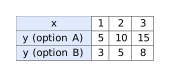
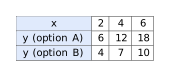
Which table shows a proportional relationship between \(x\) and \(y\)?
- Option A
- Option B
- Both A and B
- Neither


Students will build Grade 6 mastery of proportional vs. non-proportional relationships using models, equations, and test-style reasoning.
Which table shows a proportional relationship between \(x\) and \(y\)?
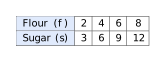
A recipe calls for 2 cups of flour for every 3 cups of sugar. Which statement correctly describes the table?
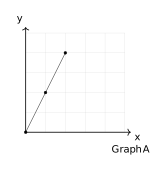
Which graph represents a proportional relationship between \(x\) and \(y\)?
A taxi charges $2 per mile traveled. If \(m\) is the number of miles and \(c\) is the total cost in dollars, which equation represents this proportional relationship?
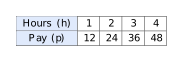
A table shows the number of hours worked (\(h\)) and the amount of pay earned (\(p\), in dollars). Which option gives both the correct unit rate and the correct equation for the relationship?
Which of the following does NOT represent a proportional relationship?
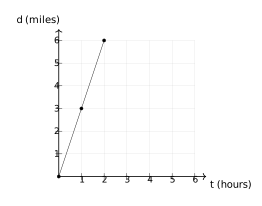
The graph below shows distance traveled (\(d\), in miles) over time (\(t\), in hours). Does the relationship show a constant speed?
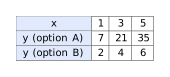
Which table represents a non-proportional relationship?
A relationship is proportional if \(y/x\) is constant. Option A has \(5/1=5\), \(10/2=5\), and \(15/3=5\), so it is proportional. Option B has \(3/1=3\) and \(5/2=2.5\), so the ratio is not constant.
The ratio of flour to sugar is \(f/s = 2/3\), \(4/6 = 2/3\), \(6/9 = 2/3\), \(8/12 = 2/3\). The ratio remains constant, so the relationship is proportional.
A proportional relationship must pass through the origin \((0, 0)\). Graph A passes through the origin; Graph B starts at \((0, 1)\), so it does not pass through the origin.
Since the taxi charges $2 per mile with no additional fee, the total cost is directly proportional to miles: \(c = 2m\). This passes through the origin when \(m = 0, c = 0\). Options B, C, and D either add a constant or reverse the relationship.
The ratio \(p/h\) is constant: \(12/1 = 24/2 = 36/3 = 48/4 = 12\). That means the unit rate is $12 per hour, and the equation \(p = 12h\) represents the proportional relationship.
Option A has a constant ratio: \(6/2 = 3\), \(12/4 = 3\), and \(18/6 = 3\). Option B does not: \(4/2 = 2\), \(7/4 = 1.75\), and \(10/6 \approx 1.67\).
A proportional distance-time graph is a straight line through the origin. Here, the line passes through \((0,0)\), \((1,3)\), and \((2,6)\), so the speed stays constant at \(3\) miles per hour.
Option A has a constant ratio: \(7/1 = 7\), \(21/3 = 7\), and \(35/5 = 7\). Option B does not: \(2/1 = 2\), \(4/3 \approx 1.33\), and \(6/5 = 1.2\), so Option B is non-proportional.
