A scale drawing uses a scale of \(1\) inch \(= 4\) feet. If a room is drawn as \(3.5\) inches wide, what is the actual width?
- \(7\) feet
- \(12\) feet
- \(14\) feet
- \(16\) feet


Students will build Grade 6 mastery of ratios with scale drawings using models, equations, and test-style reasoning.
A scale drawing uses a scale of \(1\) inch \(= 4\) feet. If a room is drawn as \(3.5\) inches wide, what is the actual width?
A map uses a scale of \(1\) cm \(= 5\) km. What actual distance does \(2\) cm on the map represent?
A scale drawing of a garden uses the scale \(1\) inch \(= 6\) feet. How long is the actual garden if the drawing shows \(2.5\) inches?
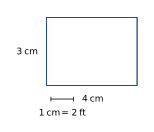
Below is a scale drawing of a room with a scale bar shown. What is the actual length of the room (the longer side)?
A scale drawing has a scale of \(1\) inch \(= 12\) feet. If the actual length of a building is \(60\) feet, what is its length in the drawing?
A map uses a scale of \(1\) inch \(= 25\) miles. Two cities are \(5\) inches apart on the map. How far apart are they in reality?
A scale of \(1\) cm \(= 3\) m is used to draw a plan. If the actual width of a room is \(9\) m, what is the width in the drawing?
A scale drawing uses a scale of \(1\) inch \(= 5\) feet. A rectangular room is drawn with dimensions \(4\) inches by \(3\) inches. What is the perimeter of the actual room?
Multiply the drawing width by the scale: \(3.5\times4=14\) feet.
Use the scale: \(2 \text{ cm} \times 5 \text{ km/cm} = 10\) km.
Multiply: \(2.5 \times 6 = 15\) feet.
The drawing shows \(4\) cm. Using the scale \(1\) cm = \(2\) ft: \(4 \times 2 = 8\) feet.
Divide the actual length by the scale factor: \(60 \div 12 = 5\) inches.
Multiply: \(5 \text{ inches} \times 25 \text{ miles/inch} = 125\) miles.
Divide: \(9 \text{ m} \div 3 \text{ m/cm} = 3\) cm.
Actual dimensions: \(4 \times 5 = 20\) feet and \(3 \times 5 = 15\) feet. Perimeter: \(2(20 + 15) = 70\) feet.
