A sweater originally costs \($40\). It is on sale for \(25\%\) off. What is the sale price?
- \($10\)
- \($15\)
- \($30\)
- \($50\)


Students will build Grade 6 mastery of solving percent problems using models, equations, and test-style reasoning.
A sweater originally costs \($40\). It is on sale for \(25\%\) off. What is the sale price?
Sarah scored \(45\) correct answers out of \(60\) questions on a math test. What percent of the questions did she answer correctly?
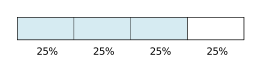
In the bar model above, the shaded region represents \(75\) students. How many students are there in total?
A jacket costs \($80\) after a \(20\%\) discount. What was the original price?
What is \(15\%\) of \($200\)?
A restaurant bill comes to \($45\). The customer wants to leave a \(20\%\) tip. How much is the tip?
Out of \(250\) students at a school, \(30\%\) participate in sports. How many students participate in sports?
If a book's price increases from \($20\) to \($24\), what is the percent increase?
\(25\%\) of \($40\) is \(0.25\times40=$10\). Sale price is \($40-$10=$30\).
To find the percent: \(\frac{45}{60}=\frac{3}{4}=0.75=75\%\).
Shaded portion is \(75\%\) of the total. If \(75\%\) equals \(75\) students, then \(100\%=\frac{75}{0.75}=100\) students.
If the discount is \(20\%\), the customer pays \(80\%\) of the original price. So \(0.80 \times \text{original} = $80\). Original \(= $80 \div 0.80 = $100\).
\(15\% \times $200 = 0.15 \times 200 = $30\).
\(20\%\) of \($45 = 0.20 \times 45 = $9.00\).
\(30\%\) of \(250 = 0.30 \times 250 = 75\) students.
Increase is \($24 - $20 = $4\). Percent increase is \(\frac{4}{20} = 0.20 = 20\%\).
