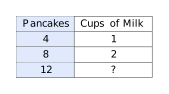
The table shows the ratio of pancakes to cups of milk needed. Which value completes the table?
- \(1\)
- \(3\)
- \(4\)
- \(6\)


Students will build Grade 6 mastery of tables of equivalent ratios using models, equations, and test-style reasoning.
The table shows the ratio of pancakes to cups of milk needed. Which value completes the table?
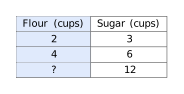
A recipe uses a ratio of \(2\) cups of flour to \(3\) cups of sugar. The table shows how much flour is needed for different amounts of sugar. What is the missing value?
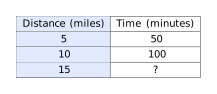
A runner completes \(5\) miles in \(50\) minutes. The table below shows equivalent distances and times. Which time is missing?
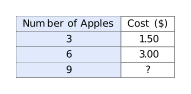
The table shows the cost of different numbers of apples at a farmer's market. How much do \(9\) apples cost?
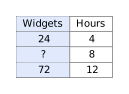
A factory produces \(24\) widgets in \(4\) hours. The table shows equivalent production rates. What is the missing number of widgets?
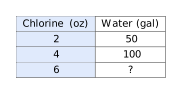
A swimming pool needs chlorine. The ratio of chlorine to water is \(2\) to \(50\). Complete the table:
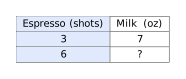
A coffee shop blends espresso and milk in a ratio of \(3:7\). How much milk is needed with \(6\) shots of espresso?
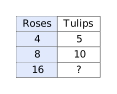
A gardener plants flowers in a ratio of roses to tulips of \(4:5\). If the gardener plants \(16\) roses, how many tulips are planted?
Every \(4\) pancakes require \(1\) cup of milk, so \(12\) pancakes require \(12\div4=3\) cups.
The ratio \(2:3\) is constant. When sugar is \(12\), multiply by \(4\): \(2\times4=8\) cups of flour.
The ratio is \(5:50\) or \(1:10\). For \(15\) miles: \(15\times10=150\) minutes.
Each apple costs \($0.50\). So \(9\) apples cost \(9\times0.50=$4.50\).
The ratio is \(24:4\) or \(6:1\). For \(8\) hours: \(6\times8=48\) widgets.
The ratio is \(2:50\) or \(1:25\). For \(6\) oz of chlorine: \(6\times25=150\) gallons.
The ratio is \(3:7\). When espresso is \(6\) (multiply by \(2\)), milk is \(7\times2=14\) oz.
The ratio is \(4:5\). When roses are \(16\) (multiply by \(4\)), tulips are \(5\times4=20\).
