Point \(A\) is located at \((3,5)\). If it is translated \(4\) units to the left and \(2\) units down, what are the coordinates of its image \(A'\)?
- \((-1,3)\)
- \((7,7)\)
- \((-1,7)\)
- \((7,3)\)


Students will build Grade 6 mastery of transformations on the coordinate plane using models, equations, and test-style reasoning.
Point \(A\) is located at \((3,5)\). If it is translated \(4\) units to the left and \(2\) units down, what are the coordinates of its image \(A'\)?
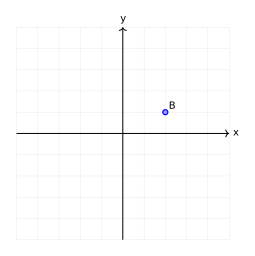
A point \(B\) at \((2,1)\) is reflected over the \(y\)-axis. What are the coordinates of \(B'\)?
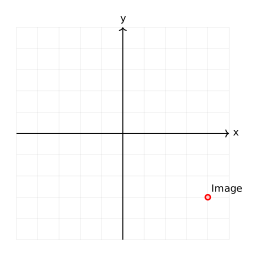
Which point, when reflected over the \(x\)-axis, results in \((4,-3)\)?
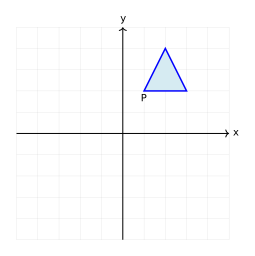
A triangle has vertices at \(P(1,2)\), \(Q(3,2)\), and \(R(2,4)\). If the triangle is translated \(3\) units right and \(1\) unit up, what are the coordinates of the image vertex \(P'\)?
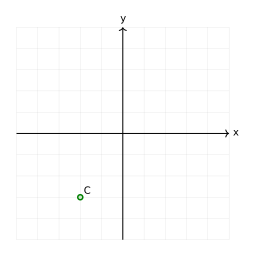
Point \(C\) is at \((-2,-3)\). When it is reflected over the \(y\)-axis, which of the following is its image?
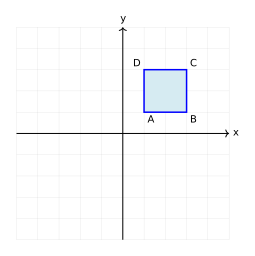
A square \(ABCD\) has vertices at \((1,1)\), \((3,1)\), \((3,3)\), and \((1,3)\). If the square is translated \(2\) units left, which will be the image of vertex \(C\)?
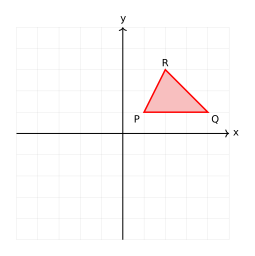
Triangle \(PQR\) is shown with vertices at \(P(1,1)\), \(Q(4,1)\), and \(R(2,3)\). If the triangle is reflected over the \(x\)-axis, what will be the coordinates of \(R'\)?
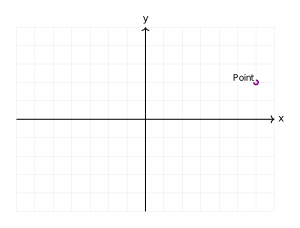
A point \((6,2)\) is reflected over the \(y\)-axis. Where does the image point appear?
Translate left by subtracting from \(x\): \(3-4=-1\). Translate down by subtracting from \(y\): \(5-2=3\). So \(A'=(-1,3)\).
Reflecting over the \(y\)-axis: negate the \(x\)-coordinate. So \((2,1) \to (-2,1)\).
Reflecting over the \(x\)-axis negates the \(y\)-coordinate. If the image is \((4,-3)\), the original is \((4,3)\).
Translation: add \(3\) to \(x\) and \(1\) to \(y\). \(P(1,2) \to P'(1+3, 2+1) = P'(4,3)\).
Reflection over the \(y\)-axis negates the \(x\)-coordinate only: \((-2,-3) \to (2,-3)\).
Translating left subtracts from \(x\): \(C(3,3) \to C'(3-2, 3) = C'(1,3)\).
Reflection over the \(x\)-axis negates the \(y\)-coordinate: \(R(2,3) \to R'(2,-3)\).
Reflection over the \(y\)-axis changes the sign of the \(x\)-coordinate: \((6,2) \to (-6,2)\).
