A worker earns \($15\) per hour. Which equation relates total earnings \(E\) to hours worked \(h\)?
- \(E=15+h\)
- \(E=15h\)
- \(E=\frac{15}{h}\)
- \(E=h-15\)


Students will build Grade 6 mastery of two quantities that change together using models, equations, and test-style reasoning.
A worker earns \($15\) per hour. Which equation relates total earnings \(E\) to hours worked \(h\)?
A car travels at a constant speed of \(60\) miles per hour. Which variable is independent?
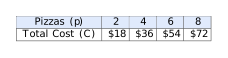
The table below shows the relationship between the number of pizzas ordered and the total cost. What is the rule that relates cost \(C\) to the number of pizzas \(p\)?
The distance \(d\) (in miles) traveled by a cyclist is related to time \(t\) (in hours) by the equation \(d = 20t\). What does the number \(20\) represent in this context?
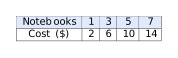
A table shows the cost of buying notebooks. Which equation best represents this relationship?
A gym membership costs \($50\) per month. If \(m\) represents the number of months and \(T\) represents the total cost, which equation is correct?
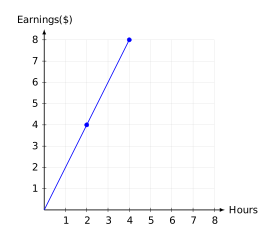
The graph below shows the relationship between the number of hours worked and earnings. Based on the graph, how much does an employee earn per hour?
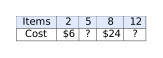
A store charges \($3\) per item. Complete the table. What are the missing costs?
Earnings equal hourly rate multiplied by hours worked: \(E=15h\).
The independent variable is what you control or choose. Time is chosen first; distance depends on time.
Each pizza costs $\(9\). Check: when \(p=2\), \(C=9(2)=18\); when \(p=4\), \(C=9(4)=36\). The rule is \(C=9p\).
In the equation \(d=20t\), \(20\) is the constant rate of change (the speed), and \(t\) is the time.
The cost is $\(2\) per notebook. Check: \(1\) notebook costs $\(2\); \(3\) notebooks cost \($6\). The equation is \(\text{Cost}=2n\).
Total cost equals $\(50\) per month times the number of months: \(T=50m\).
The graph shows the line passes through \((2,4)\) and \((4,8)\). The slope is \(\frac{8-4}{4-2}=\frac{4}{2}=2\), so the rate is $\(2\) per hour.
At $\(3\) per item: \(5\) items cost \(3 \times 5 = 15\) dollars; \(12\) items cost \(3 \times 12 = 36\) dollars.
