Two angles are supplementary. If one angle measures 65°, what is the measure of the other angle?
- 25°
- 35°
- 115°
- 295°


Students will build Grade 7 mastery of angle relationships: supplementary, complementary, and vertical angles using models, equations, and test-style reasoning.
Two angles are supplementary. If one angle measures 65°, what is the measure of the other angle?
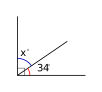
Two rays form a right angle, and a third ray splits it into complementary angles. One angle measures 34°. What is the measure of angle \(x\)?
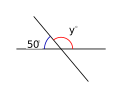
Two straight lines intersect. One angle formed is 50°. What is the measure of the angle marked \(y\)?
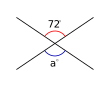
Two lines intersect forming vertical angles. One angle is 72°. What is the measure of the vertically opposite angle \(a\)?
Two angles form a linear pair. One angle measures 91°. What is the measure of the other angle?
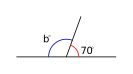
A ray splits a straight angle into two adjacent angles. One angle is 70°. Find the measure of angle \(b\).
If angle \(x\) and angle \(y\) are complementary, and \(x=37°\), what is \(y\)?
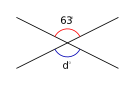
Two lines intersect. One angle measures 63°. What is the measure of the vertically opposite angle \(d\)?
Supplementary angles sum to 180°: \(180-65=115°\).
Complementary angles sum to 90°: \(x=90-34=56°\).
Adjacent angles on a straight line are supplementary: \(y=180-50=130°\).
Vertical angles are equal, so the opposite angle is also 72°.
A linear pair is supplementary: \(180-91=89°\).
Angles on a straight line are supplementary: \(180-70=110°\).
Complementary angles sum to 90°: \(y=90-37=53°\).
Vertical angles are equal. The angle opposite 63° is 63°.
