A composite figure is made of a rectangle (\(8\) ft by \(5\) ft) with a square (\(3\) ft by \(3\) ft) attached to one side. What is the total area?
- \(40\) ft\(^2\)
- \(45\) ft\(^2\)
- \(49\) ft\(^2\)
- \(56\) ft\(^2\)


Students will build Grade 7 mastery of area of composite shapes using models, equations, and test-style reasoning.
A composite figure is made of a rectangle (\(8\) ft by \(5\) ft) with a square (\(3\) ft by \(3\) ft) attached to one side. What is the total area?
A garden is shaped like an L. It consists of a \(6\) m by \(4\) m rectangle and a \(3\) m by \(3\) m square connected at a corner. Find the total area of the garden.
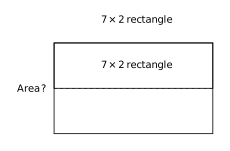
A composite figure made of two rectangles stacked vertically (both \(7\) units wide and \(2\) units tall) is shown above. What is the total area?
A floor plan shows a large rectangle \((12 \text{ ft} \times 9 \text{ ft})\) with a rectangular cutout in one corner \((4 \text{ ft} \times 3 \text{ ft})\). What is the area of the remaining floor?
A trapezoid-like composite shape is formed by a \(6\) m by \(4\) m rectangle with a triangle (\(6\) m base, \(3\) m height) on top. What is the combined area?
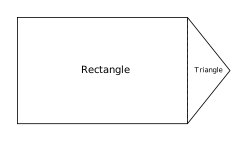
A composite figure consists of a rectangle (\(8\) units \(\times\) \(5\) units) joined with a triangle (base \(2\) units, height \(5\) units). What is the total area?
A rectangular garden is \(10\) m wide and \(8\) m tall. A triangular section is removed from the bottom, with the triangle's base being \(10\) m and height \(2\) m. What is the remaining area?
A composite shape is formed by placing a right triangle (legs \(5\) cm and \(12\) cm) next to a \(12\) cm \(\times\) \(5\) cm rectangle. What is the total area?
Decompose into two shapes: Rectangle area \(=8\times5=40\) ft\(^2\); square area \(=3\times3=9\) ft\(^2\). Add the areas: \(40+9=49\) ft\(^2\).
Rectangle: \(6 \times 4 = 24\) m\(^2\); square: \(3 \times 3 = 9\) m\(^2\). Total: \(24 + 9 = 33\) m\(^2\).
Decompose into two rectangles: First rectangle \(7 \times 2 = 14\) sq units. Second rectangle \(7 \times 2 = 14\) sq units. Add them: \(14 + 14 = 28\) sq units.
Start with the large rectangle: \(12 \times 9 = 108\) ft\(^2\). Subtract the cutout rectangle: \(4 \times 3 = 12\) ft\(^2\). Remaining area: \(108 - 12 = 96\) ft\(^2\).
Decompose into a rectangle and a triangle. Rectangle: \(6 \times 4 = 24\) m\(^2\). Triangle: \(\frac{1}{2} \times 6 \times 3 = 9\) m\(^2\). Add: \(24 + 9 = 33\) m\(^2\).
Decompose into a rectangle and a triangle. Rectangle: \(8 \times 5 = 40\) sq units. Triangle: \(\frac{1}{2} \times 2 \times 5 = 5\) sq units. Add: \(40 + 5 = 45\) sq units.
Rectangle: \(10 \times 8 = 80\) m\(^2\). Triangle removed: \(\frac{1}{2} \times 10 \times 2 = 10\) m\(^2\). Remaining: \(80 - 10 = 70\) m\(^2\).
Decompose into a rectangle and a right triangle. Rectangle: \(12 \times 5 = 60\) cm\(^2\). Right triangle: \(\frac{1}{2} \times 5 \times 12 = 30\) cm\(^2\). Add: \(60 + 30 = 90\) cm\(^2\).
