In a class of \(25\) students, \(15\) play a sport. What percent of the students play a sport?
- \(25\%\)
- \(40\%\)
- \(50\%\)
- \(60\%\)


Students will build Grade 7 mastery of connecting percents and proportions using models, equations, and test-style reasoning.
In a class of \(25\) students, \(15\) play a sport. What percent of the students play a sport?
A store sells \(120\) items in one day. If \(30\%\) of them were on sale, how many items were on sale?
What is \(0.45\) as a percent?
A school has \(280\) students. If \(35\%\) are in 7th grade, how many 7th graders are there?
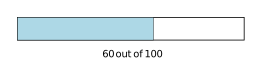
What percent is shown in the bar model above?
If \(18\%\) of a number is \(36\), what is the number?
A bicycle costs \($80\). The price is marked up by \(25\%\). What is the new price?
A recipe needs \(2\) cups of flour. If you want to make \(150\%\) of the recipe, how much flour do you need?
Set up the proportion \(\frac{15}{25}=\frac{p}{100}\). Solving gives \(p=60\), so \(60\%\) play a sport.
Using the proportion \(\frac{30}{100}=\frac{x}{120}\), cross-multiply: \(30 \times 120 = 100x\), so \(x = 36\) items.
To convert a decimal to a percent, multiply by \(100\): \(0.45 \times 100 = 45\%\). Alternatively, \(0.45 = \frac{45}{100} = 45\%\).
Set up the proportion \(\frac{35}{100}=\frac{x}{280}\). Cross-multiply: \(35 \times 280 = 100x\), giving \(x = 98\).
The shaded portion represents \(60\) out of \(100\) units. Set up the proportion: \(\frac{60}{100}=\frac{p}{100}\), so \(p = 60\%\).
Set up \(\frac{18}{100}=\frac{36}{x}\). Cross-multiply: \(18x = 3600\), so \(x = 200\).
The markup is \(\frac{25}{100} \times 80 = 20\). Add to original: \(80 + 20 = $100\).
Multiply \(2\) by \(1.5\): \(2 \times 1.5 = 3\) cups. Alternatively, using a proportion: \(\frac{150}{100} = \frac{x}{2}\), so \(x = 3\).
