How many unique triangles can be constructed with sides of length \(6\) cm, \(8\) cm, and \(10\) cm?
- \(0\)
- \(1\)
- \(2\)
- More than \(2\)


Students will build Grade 7 mastery of constructing triangles from three measurements using models, equations, and test-style reasoning.
How many unique triangles can be constructed with sides of length \(6\) cm, \(8\) cm, and \(10\) cm?
Which set of side lengths will NOT form a triangle?
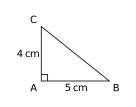
Triangle \(ABC\) with \(AB=5\) cm, \(AC=4\) cm, and a right angle at \(A\) satisfies which congruence condition?
Two triangles each have angles measuring 50°, 60°, and 70°. Are the triangles congruent?
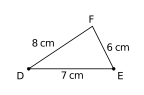
Triangle \(DEF\) has sides \(DE=7\) cm, \(EF=6\) cm, and \(FD=8\) cm. Is this triangle unique?
A triangle has sides of length \(5\) m and \(9\) m. Which length CANNOT be the third side?
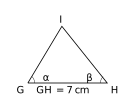
If \(GH=7\) cm and angles \(\alpha\) and \(\beta\) at \(G\) and \(H\) are known, which congruence condition applies?
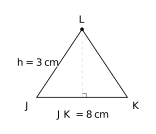
Triangle \(JKL\) has base \(JK=8\) cm and perpendicular height \(h=3\) cm. How many distinct triangles satisfy these conditions?
Given three specific side lengths that satisfy the Triangle Inequality, exactly one unique triangle (up to congruence) can be formed. In fact, this is a right triangle because \(6^2+8^2=10^2\).
The Triangle Inequality states the sum of any two sides must exceed the third. Check: \(4+6=10\) is not greater than \(9\), so this fails.
Two sides and the included right angle are given: \(AC=4\) cm, \(AB=5\) cm, and angle \(A=90°\) is between them. This is SAS (Side\textendash{}Angle\textendash{}Side) congruence.
AAA (Angle\textendash{}Angle\textendash{}Angle) guarantees similarity, not congruence. The triangles could be different sizes but the same shape. At least one side length is needed to prove congruence.
When all three side lengths are specified (7 cm, 6 cm, 8 cm), exactly one unique triangle (up to congruence) can be constructed. This is the SSS (Side\textendash{}Side\textendash{}Side) condition.
The Triangle Inequality requires the sum of any two sides to exceed the third. With sides 5 and 9: we need \(5+9>c\), so \(c<14\) m. Also \(5+c>9\), so \(c>4\) m. Thus \(4
We have angle \(\alpha\) at \(G\), the side \(GH=7\) cm between them, and angle \(\beta\) at \(H\). This is Angle\textendash{}Side\textendash{}Angle (ASA): two angles and the included side are given.
The vertex \(L\) may lie anywhere on a line parallel to \(JK\) at distance 3 cm above it. Each position yields a different triangle with the same base and height but different side lengths and angles.
