What is the shape of the cross-section formed when a cube is sliced parallel to one of its faces?
- Rectangle (but not square)
- Rhombus
- Square
- Parallelogram (but not square)


Students will build Grade 7 mastery of cross-sections of three-dimensional figures using models, equations, and test-style reasoning.
What is the shape of the cross-section formed when a cube is sliced parallel to one of its faces?
A rectangular prism has dimensions \(4\text{ cm} \times 6\text{ cm} \times 8\text{ cm}\). If a vertical plane cuts through it perpendicular to the base, which shape MUST appear in the cross-section?
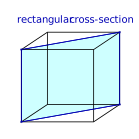
A plane cuts diagonally through the cube as shown. What is the shape of the resulting cross-section?
When a cylinder is cut by a horizontal plane parallel to its circular bases, what is the shape of the cross-section?
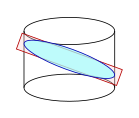
A cylinder is sliced by an oblique plane, as shown. What is the shape of the resulting cross-section?
Which of the following statements is true about cross-sections of a cube?
A cone is sliced horizontally (parallel to its circular base). What is the shape of the cross-section?
A pyramid with a square base is sliced parallel to its base. Which statement about the cross-section is correct?
A cube has all square faces. A cut parallel to any face produces a square cross-section congruent to that face.
Any vertical plane perpendicular to the base of a rectangular prism intersects the solid in a rectangular cross-section (width is one base dimension, height is the prism height).
A plane through opposite edges of a cube forms a rectangular cross-section. One pair of sides equals the edge length; the other pair equals the face diagonal (\(a\sqrt{2}\) for edge \(a\)).
A horizontal plane parallel to the bases of a cylinder creates a circular cross-section congruent to the bases. The radius of this circle equals the radius of the cylinder.
When a plane cuts through a cylinder at an angle (not parallel to the bases and not perpendicular to the axis), the cross-section is an ellipse.
Depending on the angle and position of the cutting plane, a cube's cross-section may have 3, 4, 5, or 6 sides. A triangle results from a corner cut; rectangles from parallel cuts; hexagons from diagonal cuts at certain angles.
A horizontal plane parallel to the base of a cone produces a circular cross-section smaller than the original base. The circle is similar to the base but scaled down based on the height of the cut.
A square pyramid cut parallel to its base produces a square cross-section. This square is similar to the base but smaller in size, with the side length proportional to the distance from the apex.
