A cylinder has a radius of \(3\) m and a height of \(5\) m. What is its volume? Use \(\pi\approx3.14\).
- \(47.1\) m\(^3\)
- \(94.2\) m\(^3\)
- \(141.3\) m\(^3\)
- \(235.5\) m\(^3\)


Students will build Grade 7 mastery of cylinder surface area and volume using models, equations, and test-style reasoning.
Choose a free PDF. Each has different questions and worked solutions. The preview shows the student question page; open the PDF to read or print it at full size.
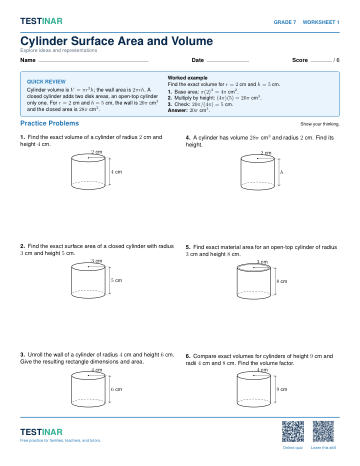 Worksheet 1
6 problems
Includes math models and calculations.
Open PDF
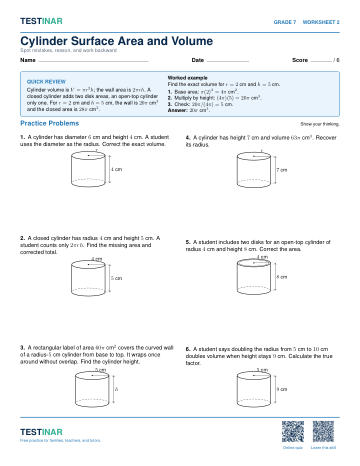 Worksheet 2
6 problems
Includes correcting mistakes and working backward.
Open PDF
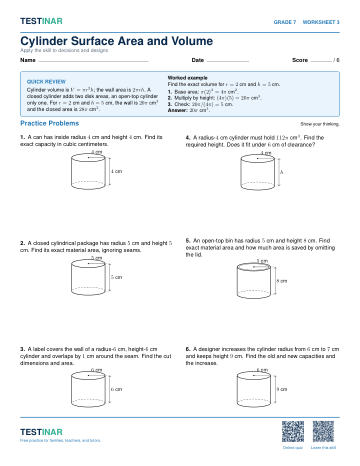 Worksheet 3
6 problems
Includes word problems and math models.
Open PDF
Print page 1 for students. Page 2 has the solutions; page 3 has optional book recommendations.
These online questions are separate from the three PDF worksheets above.
A cylinder has a radius of \(3\) m and a height of \(5\) m. What is its volume? Use \(\pi\approx3.14\).
A soup can has a radius of \(2\) inches and a height of \(4\) inches. What is the volume of the can? Use \(\pi\approx3.14\).
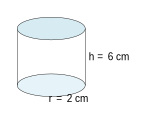
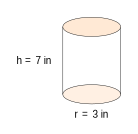
What is the volume of the cylinder shown? Use \(\pi\approx3.14\).
A water tank in the shape of a cylinder has a radius of \(4\) feet and a height of \(10\) feet. Find the volume. Use \(\pi\approx3.14\).
A cylindrical drum has a radius of \(1.5\) m and a height of \(2\) m. What is its volume? Use \(\pi\approx3.14\).
Which formula gives the volume of the cylinder shown?
A cylindrical pasta jar has a radius of \(5\) cm and a height of \(15\) cm. What is the surface area of the jar (including both circular ends)? Use \(\pi\approx3.14\).
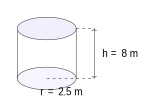
Find the lateral surface area (curved side only) of the cylinder shown. Use \(\pi\approx3.14\).
Volume of a cylinder \(=\pi r^2 h\approx3.14\times3^2\times5=3.14\times9\times5=141.3\) m\(^3\).
\(V = \pi r^2 h \approx 3.14 \times 2^2 \times 4 = 3.14 \times 4 \times 4 = 50.24\) in\(^3\).
\(V = \pi r^2 h \approx 3.14 \times 2^2 \times 6 = 3.14 \times 4 \times 6 = 75.36\) cm\(^3\).
\(V = \pi r^2 h \approx 3.14 \times 4^2 \times 10 = 3.14 \times 16 \times 10 = 502.4\) ft\(^3\).
\(V = \pi r^2 h \approx 3.14 \times 1.5^2 \times 2 = 3.14 \times 2.25 \times 2 = 14.13\) m\(^3\).
The volume formula is \(V = \pi r^2 h\). With \(r=3\) and \(h=7\), this is \(\pi \times 3^2 \times 7\).
\(SA = 2\pi r^2 + 2\pi rh = 2(3.14)(5^2) + 2(3.14)(5)(15) = 157 + 471 = 628\) cm\(^2\).
Lateral area \(= 2\pi rh \approx 2 \times 3.14 \times 2.5 \times 8 = 125.6\) m\(^2\).
