How many distinct triangles can be drawn with side lengths \(5\) cm, \(7\) cm, and \(12\) cm?
- \(0\)
- \(1\)
- \(2\)
- Infinitely many


Students will build Grade 7 mastery of drawing geometric figures with given conditions using models, equations, and test-style reasoning.
How many distinct triangles can be drawn with side lengths \(5\) cm, \(7\) cm, and \(12\) cm?
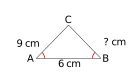
A triangle has side lengths of \(6\) cm and \(9\) cm. Which length CANNOT be the third side?
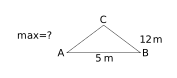
Greta wants to draw a triangle with sides \(5\) m and \(12\) m. If the third side is a whole number of meters, what is the maximum possible length?
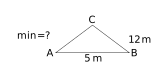
What is the minimum possible length (in whole meters) for the third side of a triangle with sides \(5\) m and \(12\) m?
Can a triangle be drawn with side lengths \(2.5\) cm, \(3.5\) cm, and \(6\) cm?
Which set of conditions does NOT uniquely determine a triangle?
Two sides of a triangle measure \(7\) cm and \(10\) cm. The angle between them is 60°. How many distinct triangles can be drawn?
A rectangle is inscribed in a circle. One side is \(8\) cm and an adjacent side is \(6\) cm. Is there a unique rectangle that satisfies these conditions?
By the Triangle Inequality, \(5+7=12\). Since the sum of two sides must be STRICTLY greater than the third, no triangle exists.
By Triangle Inequality, \(|9-6| < c < 9+6\) gives \(3 < c < 15\). Choice C (\(16\) cm) exceeds \(15\), so it fails. A: \(5 > 3\) ✓. B: \(10 < 15\) ✓. D: \(8 < 15\) ✓.
By Triangle Inequality, the third side \(c\) must satisfy \(5+12 > c\), so \(c < 17\). The greatest whole number less than \(17\) is \(16\).
The third side \(c\) must satisfy \(|12-5| < c\), so \(c > 7\). The smallest whole number greater than \(7\) is \(8\).
The sum of the two smaller sides equals (not exceeds) the largest side, violating the strict Triangle Inequality.
This condition (sometimes called the "ambiguous case") can produce 0, 1, or 2 different triangles, unlike the others, which uniquely determine a triangle.
When two sides and the angle between them are given, exactly one triangle can be constructed (up to congruence).
Given two adjacent sides of a rectangle (8 cm and 6 cm), the rectangle is completely determined. The circle's radius is half the diagonal length \(\sqrt{8^2+6^2}/2 = 5\) cm.
