Which number line represents the inequality \(x>-2\)?
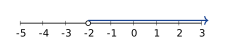
- Open circle at \(-2\) pointing right
- Closed circle at \(-2\) pointing right
- Open circle at \(-2\) pointing left
- Open circle at \(0\) pointing right


Students will build Grade 7 mastery of graphing solutions to inequalities on a number line using models, equations, and test-style reasoning.
Which number line represents the inequality \(x>-2\)?
Which number line represents the inequality \(x \leq 3\)?
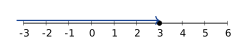
Which inequality is represented by the number line below?

Which inequality is represented by the number line below?
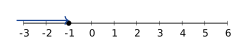
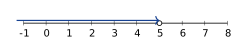
Identify the number line that correctly represents \(x < 5\).
Which number line represents the inequality \(x \geq -3\)?
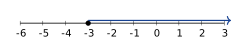
What inequality does this number line represent?
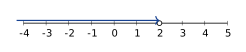
Which inequality is shown on this number line?
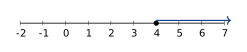
\(x>-2\) means strictly greater than (does not include) \(-2\), so use an open circle at \(-2\) and an arrow pointing right toward larger values.
\(x \leq 3\) means less than or equal to \(3\) (includes 3), so use a closed circle at the boundary \(3\) and an arrow pointing left toward smaller values.
An open circle at \(0\) with an arrow pointing right indicates all values greater than \(0\), which is \(x > 0\).
A closed circle at \(-1\) with an arrow pointing left indicates all values less than or equal to \(-1\), which is \(x \leq -1\).
\(x < 5\) uses an open circle (excludes \(5\)) and an arrow pointing left (toward smaller values less than \(5\)).
\(x \geq -3\) means greater than or equal to \(-3\) (includes \(-3\)), so use a closed circle at the boundary \(-3\) and an arrow pointing right.
An open circle at \(2\) with an arrow pointing left shows all values strictly less than \(2\), which is \(x < 2\).
A closed circle at \(4\) with a right-pointing arrow indicates \(x \geq 4\) (greater than or equal to \(4\)).
