What is \(\sqrt{144}\)?
- \(10\)
- \(11\)
- \(12\)
- \(14\)


Students will build Grade 7 mastery of introduction to square roots using models, equations, and test-style reasoning.
What is \(\sqrt{144}\)?
Which number is a perfect square?
What is \(\sqrt{49}\)?
A square garden has an area of \(100\) square meters. What is the length of one side of the garden?
What is \(\sqrt{64}\)?
Which of the following is NOT a perfect square?
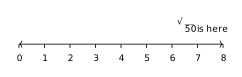
Between which two consecutive integers does \(\sqrt{50}\) lie?
What is \(\sqrt{225}\)?
Because \(12\times12=144\), the square root of \(144\) is \(12\).
Perfect squares are numbers like \(4\), \(9\), \(16\), \(25\) that are products of a whole number times itself. Since \(5 \times 5 = 25\), it is a perfect square.
\(7 \times 7 = 49\), so \(\sqrt{49} = 7\).
The area of a square is \(s^2\). If the area is \(100\), then \(s^2 = 100\), so \(s = \sqrt{100} = 10\) meters.
\(8 \times 8 = 64\), therefore \(\sqrt{64} = 8\).
Perfect squares: \(81 = 9^2\), \(121 = 11^2\), \(169 = 13^2\). The number \(72\) is not a perfect square since no whole number times itself equals \(72\).
\(7^2 = 49\) and \(8^2 = 64\). Since \(49 < 50 < 64\), we know \(7 < \sqrt{50} < 8\).
\(15 \times 15 = 225\), so \(\sqrt{225} = 15\).
