A spinner has \(4\) equal sections labeled \(1, 2, 3, 4\). Which statement is FALSE for this uniform probability model?
- \(P(1)=\frac{1}{4}\)
- \(P(\text{odd})=\frac{1}{2}\)
- \(P(\text{greater than }2)=\frac{1}{2}\)
- \(P(5)=\frac{1}{4}\)


Students will build Grade 7 mastery of probability models using models, equations, and test-style reasoning.
A spinner has \(4\) equal sections labeled \(1, 2, 3, 4\). Which statement is FALSE for this uniform probability model?
A spinner has \(8\) equal sections: \(4\) red, \(2\) blue, \(1\) green, \(1\) yellow. What is \(P(\text{red})\) for this uniform model?
Which spinner represents a non-uniform probability model?

A bag contains \(3\) red marbles, \(5\) blue marbles, and \(2\) green marbles. Which probability is correct?
A spinner is divided into \(6\) equal sections labeled \(A, A, B, C, C, C\). What is \(P(C)\)?
A weather model predicts: \(P(\text{rain})=0.3\), \(P(\text{cloudy})=0.5\), \(P(\text{sunny})=0.2\). Which statement is true?
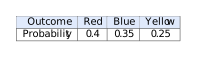
Does this table represent a valid probability model?
A card is drawn from a standard deck of \(52\) cards. What is \(P(\text{King})\)?
\(5\) is not on the spinner, so \(P(5)=0\). The others are correct.
There are \(4\) red sections out of \(8\) total, so \(P(\text{red})=\frac{4}{8}=\frac{1}{2}\).
The left spinner has equal sections (uniform). The right spinner has unequal sectors: one 60°, one 120°, one 180° (non-uniform).
Total marbles: \(3+5+2=10\). Red: \(3\) out of \(10\) gives \(\frac{3}{10}\). (Blue would be \(\frac{5}{10}\), green \(\frac{2}{10}\), not red \(\frac{7}{10}\)).
There are \(3\) sections labeled \(C\) out of \(6\) equal sections, so \(P(C)=\frac{3}{6}=\frac{1}{2}\).
\(0.3 + 0.5 + 0.2 = 1\), so probabilities sum to \(1\) (valid). Outcomes have different probabilities (non-uniform). Also, \(P(\text{not sunny})=0.3+0.5=0.8\).
\(0.4 + 0.35 + 0.25 = 1.0\) and each probability is in \([0, 1]\), so this is valid.
There are \(4\) Kings in \(52\) cards, so \(P(\text{King})=\frac{4}{52}=\frac{1}{13}\).
