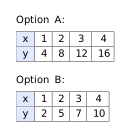
Which table shows a proportional relationship between \(x\) and \(y\)?
- Neither
- Option B only
- Both A and B
- Option A only


Students will build Grade 7 mastery of recognizing proportional relationships using models, equations, and test-style reasoning.
Which table shows a proportional relationship between \(x\) and \(y\)?
A smoothie recipe uses \(2\) cups of berries for every \(3\) cups of yogurt. If you use \(8\) cups of berries, how many cups of yogurt do you need?
Which equation represents a proportional relationship?
A car travels at a constant speed. After \(2\) hours, it has gone \(110\) miles. After \(5\) hours, it has gone \(275\) miles. Is the distance proportional to time?
Which table does NOT show a proportional relationship?
A recipe calls for \(\frac{1}{2}\) cup of flour for every \(\frac{1}{4}\) cup of sugar. Which ratio represents the proportional relationship?
The graph of which equation is a straight line passing through the origin?
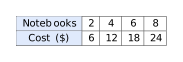
Jamal buys notebooks at $3 each. The table below shows his total cost for different numbers of notebooks. Does the table show a proportional relationship?
Check constant \(y/x\): A gives \(4,4,4,4\) (constant — proportional). B gives \(2,2.5,2.33,2.5\) (not constant).
Set up proportion: \(\frac{2}{3} = \frac{8}{y}\). Cross multiply: \(2y = 24\), so \(y = 12\).
Proportional relationships have form \(y = kx\) (passing through origin with no constant term). Only \(y = 7x\) fits.
Check the constant-of-proportionality across rows: \(\frac{110}{2} = 55\) mph and \(\frac{275}{5} = 55\) mph. The ratio is constant, so distance is proportional to time.
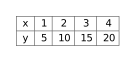
The table has ratio \(y/x: 5/1=5, 10/2=5, 15/3=5, 20/4=5\) (constant). Option B: \(y=6x\) is proportional. Option C: line through origin \((0,0)\) and \((3,12)\) has slope \(4\), so \(y=4x\) (proportional). All are proportional.
Divide: \(\frac{1/2}{1/4} = \frac{1}{2} \times \frac{4}{1} = 2\). For every 1 cup sugar, you need 2 cups flour.
Proportional equations pass through origin: substitute \(x=0\), get \(y=0\). Only \(y=-5x\) gives \((0,0)\).
Each row: \(6/2=3\), \(12/4=3\), \(18/6=3\), \(24/8=3\). Constant ratio of 3 dollars per notebook.
