A coin is flipped and a six-sided die is rolled. How many outcomes are in the sample space?
- \(6\)
- \(8\)
- \(12\)
- \(36\)


Students will build Grade 7 mastery of sample spaces for compound events using models, equations, and test-style reasoning.
A coin is flipped and a six-sided die is rolled. How many outcomes are in the sample space?
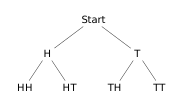
Two coins are flipped. Which tree diagram shows all possible outcomes?
A spinner is divided into 3 equal sections (Red, Blue, Yellow), and a fair coin is flipped. How many total outcomes are possible?
A student chooses a shirt from 5 options and pants from 3 options. How many different outfits are possible?
A fair die is rolled twice. What is the total number of outcomes in the sample space?
A menu offers 4 drinks, 6 main courses, and 3 desserts. How many complete meals can be ordered if you choose one of each?
Two spinners are spun. The first spinner has sections labeled 1, 2, and 3. The second spinner has sections labeled A and B. How many outcomes are in the sample space?
A coin is flipped and a number is chosen from a spinner with sections 1, 2, 3, 4. How many favorable outcomes result in a heads and an odd number?
The coin has \(2\) outcomes and the die has \(6\). By the counting principle: \(2\times6=12\) total outcomes.
The tree shows all branches: HH, HT, TH, TT. That is \(4\) equally likely outcomes.
The spinner has \(3\) outcomes and the coin has \(2\) outcomes. Using the counting principle: \(3 \times 2 = 6\) total outcomes.
By the counting principle: \(5\) shirts \(\times\) \(3\) pants \(= 15\) different outfits.
First roll has \(6\) outcomes; second roll has \(6\) outcomes. Total: \(6 \times 6 = 36\) outcomes.
By the counting principle: \(4 \times 6 \times 3 = 72\) complete meal combinations.
First spinner: \(3\) outcomes; second spinner: \(2\) outcomes. Total: \(3 \times 2 = 6\) outcomes.
Total outcomes: \(2 \times 4 = 8\). Favorable (Heads and odd): H1, H3. That is \(2\) favorable outcomes.
