Two triangles are similar. The sides of the smaller triangle are \(3\), \(4\), and \(5\). The longest side of the larger triangle is \(15\). What is the length of the shortest side of the larger triangle?
- \(6\)
- \(8\)
- \(9\)
- \(12\)


Students will build Grade 7 mastery of similar figures and proportions using models, equations, and test-style reasoning.
Two triangles are similar. The sides of the smaller triangle are \(3\), \(4\), and \(5\). The longest side of the larger triangle is \(15\). What is the length of the shortest side of the larger triangle?
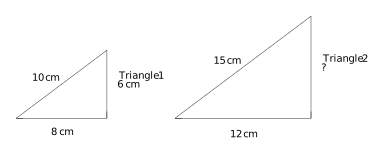
Triangles 1 and 2 are similar right triangles. What is the length of the missing side in Triangle 2?
Two similar rectangles have a scale factor of \(2:5\). If the smaller rectangle has a perimeter of \(28\) inches, what is the perimeter of the larger rectangle?
Two similar triangles have corresponding sides in the ratio \(3:7\). If an angle in the smaller triangle measures 45°, what is the measure of the corresponding angle in the larger triangle?
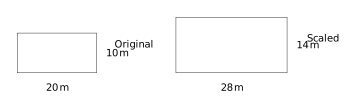
The two rectangles are similar. What is the scale factor from the original to the scaled rectangle?
Two similar isosceles triangles have areas in the ratio \(4:25\). What is the ratio of their corresponding sides?
In a map, a scale of \(1\) inch \(= 50\) miles is used. On the map, two cities are \(3.5\) inches apart. What is the actual distance between the cities?
A photograph has dimensions \(6\) inches by \(8\) inches. It is enlarged so that the longer side becomes \(20\) inches. What is the length of the shorter side after enlargement?
The scale factor is \(15\div5=3\). The shortest side of the larger triangle is \(3\times3=9\).
The scale factor from Triangle 1 to Triangle 2 is \(\frac{12}{8}=1.5\). The missing side is \(6 \times 1.5 = 9\) cm.
The perimeter scales with the same factor as the sides. If the scale factor is \(2:5\), then \(\frac{\text{smaller}}{\text{larger}}=\frac{2}{5}\), so \(\text{larger}=28\times\frac{5}{2}=70\) inches.
Corresponding angles in similar figures are congruent, regardless of the scale factor. The corresponding angle is also 45°.
The scale factor is \(\frac{28}{20}=1.4\). We can verify: \(10 \times 1.4 = 14\) \checkmark
Area scales by the square of the linear scale factor. If areas are \(4:25\), then the linear scale factor is \(\sqrt{4}:\sqrt{25}=2:5\).
Using the scale: \(3.5 \text{ inches} \times 50 \text{ miles/inch} = 175\) miles.
The scale factor is \(\frac{20}{8}=2.5\). The shorter side is \(6 \times 2.5 = 15\) inches.
