What is \(30\%\) of \(150\)?
- A \(30\)
- B \(180\)
- C \(50\)
- D \(45\)
Check answer and explanation
Answer D: \(45\)
\(30\%\) of \(150\) is \(0.30\times150=45\).


A focused Grade 7 learning session for Solving Percent Problems using visual models, worked examples, strategy guidance, and a short mastery check.
Student goal: I can solve problems involving solving percent problems.
Solving Percent Problems is part of Grade 7 Percents and Financial Literacy. This activity focuses on the central idea students need before they move into independent practice.
Students will build Grade 7 mastery of solving percent problems using models, equations, and test-style reasoning.
| What to notice | How to use it |
|---|---|
| Numbers, units, labels, diagrams, or graphs | Identify what each part represents before calculating. |
| The relationship in the problem | Connect the model to an equation, comparison, or explanation. |
Use the figures and worked questions in the practice set below as the visual model for this skill.
Read the first practice question slowly. Decide what the question is asking, choose a strategy, solve, and then compare your reasoning with the answer explanation.
For Solving Percent Problems, a strong worked example should show the setup, the calculation or model, and a final answer that matches the context.
Many Grade 7 test questions use real situations. Look for quantities, units, rates, measures, expressions, or data values that connect the math to the story.
After solving, explain what the answer means in the situation, not just the number you calculated.
I can solve problems involving solving percent problems.
Use the warmup, guided question, practice set, and exit questions below to check whether this skill is ready or needs more practice.
Use scratch paper. The explanation matters more than simply seeing whether the choice is correct.
What is \(30\%\) of \(150\)?
Answer D: \(45\)
\(30\%\) of \(150\) is \(0.30\times150=45\).
A soccer team won \(75\%\) of their \(20\) games. How many games did they win?
Answer C: \(15\)
\(75\%\) of \(20\) is \(0.75 \times 20 = 15\) games.
What percent of \(80\) is \(20\)?
Answer D: \(25\%\)
\(\frac{20}{80} = \frac{1}{4} = 0.25 = 25\%\).
A store has a \(40\%\) off sale. If a jacket originally costs \($80\), what is the discount?
Answer D: \($32\)
The discount is \(40\%\) of \($80\): \(0.40 \times 80 = 32\) dollars.
If \(12\) is \(15\%\) of a number, what is the number?
Answer C: \(80\)
If \(12 = 0.15 \times n\), then \(n = \frac{12}{0.15} = 80\).
The grid above shows a percent model. What percent is shaded?
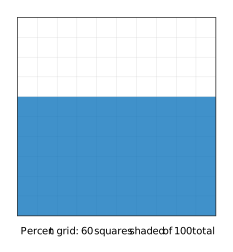
Answer C: \(60\%\)
The shaded region is \(\frac{60}{100} = 60\%\) of the grid.
Maria scored \(85\%\) on a test with \(40\) questions. How many questions did she answer correctly?
Answer C: \(34\)
\(85\%\) of \(40\) is \(0.85 \times 40 = 34\) questions.
If a bicycle costs \($120\) and the sales tax is \(8\%\), what is the tax amount?
Answer D: \($9.60\)
The tax is \(8\%\) of \($120\): \(0.08 \times 120 = 9.60\) dollars.
What is \(5\%\) of \(200\)?
Answer D: \(10\)
\(5\%\) of \(200\) is \(0.05 \times 200 = 10\).
By how much did the video game price increase?
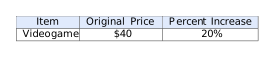
Answer D: \($8\)
A \(20\%\) increase of \($40\) is \(0.20 \times 40 = 8\) dollars.
A restaurant bill is \($50\). If you tip \(18\%\), what is the tip amount?
Answer C: \($9\)
The tip is \(18\%\) of \($50\): \(0.18 \times 50 = 9\) dollars.
