Point \(P(4,-3)\) is reflected over the \(x\)-axis. What are the coordinates of the image \(P'\)?
- \((-4,-3)\)
- \((-4,3)\)
- \((4,3)\)
- \((4,-3)\)


Students will build Grade 7 mastery of transformations on the coordinate plane using models, equations, and test-style reasoning.
Point \(P(4,-3)\) is reflected over the \(x\)-axis. What are the coordinates of the image \(P'\)?
Which transformation moves the point \(Q(-5, 2)\) to \(Q'(5, 2)\)?
A triangle with vertices at \(A(1,1)\), \(B(3,1)\), and \(C(2,3)\) is translated by the vector \((2, -4)\). What is the image of vertex \(B\) after this translation?
Point \(R(2, 5)\) is reflected over the line \(y=x\). What are the new coordinates?
Which of the following is an example of a rigid transformation (one that preserves distance and angles)?
A quadrilateral \(ABCD\) has vertices \(A(0,0)\), \(B(4,0)\), \(C(4,3)\), and \(D(0,3)\). If the quadrilateral is translated by \((-2, 1)\), which of the following is the new location of vertex \(C\)?
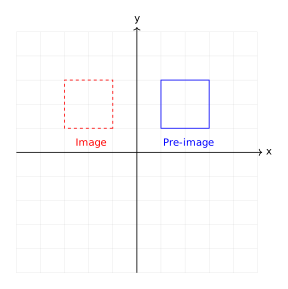
Which transformation maps the blue figure (pre-image) to the red figure (image)?
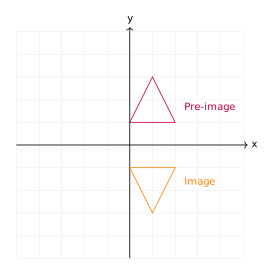
Which transformation maps the purple triangle to the orange triangle?
A reflection over the \(x\)-axis flips the sign of the \(y\)-coordinate: \((4,-3)\to(4,3)\).
Reflection over the \(y\)-axis uses the rule \((x, y)\to(-x, y)\). The \(x\)-coordinate changes sign; the \(y\)-coordinate stays the same. So \((-5, 2)\to(5, 2)\). Check: (A) Translation by \((5, 0)\) gives \((-5+5, 2)=(0, 2)\), not \((5, 2)\). (C) Reflection over \(x\)-axis gives \((-5, -2)\). (D) 180° rotation gives \((5, -2)\).
A translation by \((2, -4)\) adds the vector to each point: \((3, 1)+(2, -4)=(5, -3)\).
Reflection over \(y=x\) uses the rule \((x, y)\to(y, x)\), swapping the coordinates: \((2, 5)\to(5, 2)\).
A rigid transformation preserves all distances and angles. Reflection, rotation, and translation are rigid. Dilation (option B) and shearing (option D) change size or shape, so they are not rigid.
Applying the translation vector to \(C(4, 3)\): \((4, 3)+(-2, 1)=(2, 4)\).
The blue square at \(x\in[1,3]\) maps to the red square at \(x\in[-3,-1]\). This is a reflection over the \(y\)-axis.
The purple triangle vertices have \(y\)-values \(1, 1, 3\), which become \(-1, -1, -3\) in the orange triangle, indicating a reflection over the \(x\)-axis.
