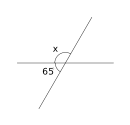
Two lines intersect. One angle measures 65°. What is \(x\), the measure of an adjacent angle?
- 25°
- 65°
- 115°
- 155°


Learn to reason about and solve Grade 8 problems involving Angle Relationships.
Two lines intersect. One angle measures 65°. What is \(x\), the measure of an adjacent angle?
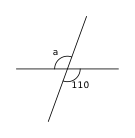
Two lines intersect. One angle is 110°. What is \(a\), the measure of the vertical angle?
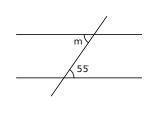
Two parallel lines are cut by a transversal. If the lower angle is 55°, what is \(m\), the alternate interior angle?
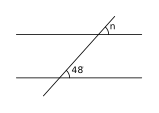
Two parallel lines are cut by a transversal. One angle below the transversal measures 48°. What is \(n\), the corresponding angle above the line?
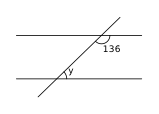
Two parallel lines are cut by a transversal. One co-interior (same-side interior) angle is 136°. What is \(y\), the other co-interior angle?
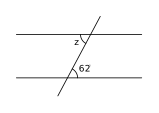
Two parallel lines are cut by a transversal. The angle marked 62° and angle \(z\) are alternate interior angles. What is \(z\)?
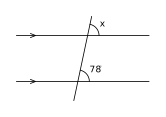
Two parallel lines are cut by a transversal. One angle measures 78°. What is \(x\), the measure of the corresponding angle on the upper parallel line?
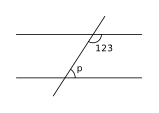
Two parallel lines are cut by a transversal. The angle \(p\) and the 123° angle are co-interior angles. What is \(p\)?
Adjacent angles on a straight line are supplementary, so they sum to 180°. Thus \(x = 180 - 65 = 115°\).
Vertical angles are congruent. When two lines intersect, opposite angles are equal, so \(a = 110°\).
Alternate interior angles are congruent when a transversal cuts parallel lines. So \(m = 55°\).
Corresponding angles formed by a transversal cutting parallel lines are congruent. So \(n = 48°\).
Co-interior angles are supplementary when a transversal cuts parallel lines. So \(y = 180 - 136 = 44°\).
Alternate interior angles formed by a transversal cutting parallel lines are congruent. So \(z = 62°\).
Corresponding angles are congruent when a transversal cuts parallel lines. So \(x = 78°\).
Co-interior angles sum to 180°. So \(p = 180 - 123 = 57°\).
