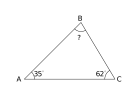
In triangle \(ABC\), angle \(A\) measures 35° and angle \(C\) measures 62°. What is angle \(B\)?
- 73°
- 83°
- 93°
- 103°


Learn to reason about and solve Grade 8 problems involving Angles in Triangles and Parallel Lines.
In triangle \(ABC\), angle \(A\) measures 35° and angle \(C\) measures 62°. What is angle \(B\)?
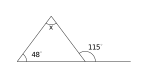
In the diagram below, the exterior angle of a triangle measures 115°. If one remote interior angle is 48°, what is the other remote interior angle?
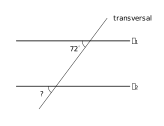
Two parallel lines are cut by a transversal. If one corresponding angle is 72°, what is the other corresponding angle?
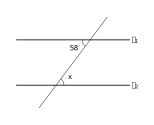
In the diagram, lines \(\ell_1\) and \(\ell_2\) are parallel. Find the measure of angle \(x\).
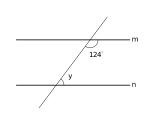
Lines \(m\) and \(n\) are parallel, cut by a transversal. If one co-interior angle is 124°, what is the other co-interior angle?
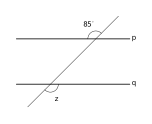
In the figure, parallel lines are cut by a transversal. If the angle marked is 85°, find the alternate exterior angle.
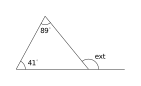
A triangle has interior angles of 41° and 89°. What is the exterior angle adjacent to the third interior angle?
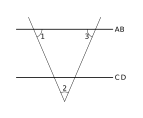
In the diagram, \(AB \parallel CD\). If angle \(1\) is 63° and angle \(2\) is 95°, what is angle \(3\)?
Triangle angle sum: \(180 - 35 - 62 = 83°\).
An exterior angle equals the sum of the two remote interior angles: \(115 = 48 + x\), so \(x = 67°\).
Corresponding angles formed by parallel lines and a transversal are congruent.
Alternate interior angles formed by parallel lines and a transversal are congruent.
Co-interior angles (same-side interior angles) are supplementary: \(124 + y = 180\), so \(y = 56°\).
Alternate exterior angles are congruent when lines are parallel.
The third interior angle is \(180 - 41 - 89 = 50°\). The exterior angle is \(180 - 50 = 130°\) (or sum of remote interior angles: \(41 + 89 = 130°\)).
Angle 1 (63°) and angle 2 (95°) form a triangle with angle 3. The angle corresponding to angle 1 (by the parallel line property) is 63°. Then by triangle angle sum: angle 3 = \(180 - 63 - 95 = 22°\).
