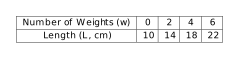
A spring stretches when weights are attached. The table shows the length \(L\) (in cm) for a spring with \(w\) weights attached. Which equation describes the relationship?
- \(L=2w+10\)
- \(L=10w+2\)
- \(L=4w+10\)
- \(L=w+10\)
Learn to reason about and solve Grade 8 problems involving Building Linear Functions.
A spring stretches when weights are attached. The table shows the length \(L\) (in cm) for a spring with \(w\) weights attached. Which equation describes the relationship?
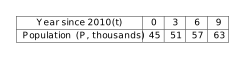
A town's population \(P\) (in thousands) at year \(t\) (years since 2010) follows this data: What is the rate of change of the population per year?
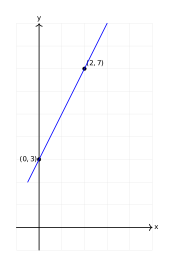
The graph shows a linear function passing through points \((0, 3)\) and \((2, 7)\). What is the slope of the line?
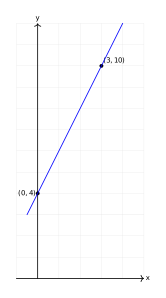
The graph shows a line passing through \((0, 4)\) and \((3, 10)\). What is the equation of the line?
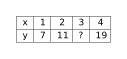
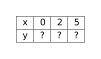
The table shows a linear function. Find the missing \(y\) value.
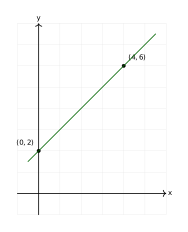
The graph shows a linear function. What are the slope and \(y\)-intercept?
Using the equation \(y=3x-5\), complete the table: What is the sum of the three \(y\) values?
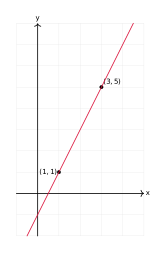
The graph below shows a line. Which equation represents this line?
Initial length is \(10\) cm (when \(w=0\)). Change from 2 to 4 weights: length goes from 14 to 18 cm, a change of 4 cm for 2 weights, so slope is \(2\). Equation: \(L=2w+10\).
Slope is \(\frac{\Delta P}{\Delta t}=\frac{6}{3}=2\) thousand per year from \(t=0\) to \(t=3\) (or any consecutive pair).
Slope is \(m=\frac{y_2-y_1}{x_2-x_1}=\frac{7-3}{2-0}=\frac{4}{2}=2\).
\(y\)-intercept is 4. Slope is \(\frac{10-4}{3-0}=\frac{6}{3}=2\). Equation: \(y=2x+4\).
Slope is \(\frac{11-7}{2-1}=4\). When \(x=3\): \(y=11+4=15\).
\(y\)-intercept is 2 (at \(x=0\)). Slope is \(\frac{6-2}{4-0}=\frac{4}{4}=1\).
For \(x=0\), \(y=-5\). For \(x=2\), \(y=1\). For \(x=5\), \(y=10\). The sum is \(-5+1+10=6\).
Slope: \(m=\frac{5-1}{3-1}=\frac{4}{2}=2\). Using point \((1,1)\): \(1=2(1)+b \Rightarrow b=-1\). Equation: \(y=2x-1\).